


A Mercedes that hesitates when you roll into the throttle, feels flat in the midrange, or drops into limp mode on the highway is often running on bad math. Air mass is one of the key inputs the engine computer uses to calculate load and fueling, and that number comes from the mass air flow sensor. When it drifts, everything downstream drifts with it.
The MAF is a real failure point on Mercedes engines. It’s also a part we regularly see replaced in our Mercedes repair and service work before the fault has actually been proven — because an airflow code is evidence, not a diagnosis. This guide covers what genuine MAF failure looks like, what mimics it convincingly, and how proper Mercedes diagnostics tells the two apart. It applies to Mercedes gasoline engines equipped with a MAF sensor — sensor layout and diagnostic strategy vary by engine.
- Symptoms often arrive before codes. A drifting sensor can make the car feel lazy before it sets a hard fault.
- A MAF code isn’t a sensor verdict. P0101 in particular can be triggered by air the sensor never measured.
- Unmetered air is a classic imposter. A split duct or breather leak can mimic MAF symptoms and set plausibility or lean faults.
- Cleaning doesn’t fix drift. It can help genuine contamination, but a drifted element doesn’t clean back to spec.
- The pattern matters as much as the code. When it happens — cold, warm, under load — narrows the search fastest.
- Testing settles it in one visit. Measured air mass, fuel-trim behavior, and a smoke test separate sensor from leak.
What does a failing MAF sensor feel like in a Mercedes?
Owners often notice hesitation, weak midrange power, and an unstable idle before any warning light appears.
That order surprises people. A MAF sensor often degrades rather than dying outright, reporting a number that is wrong but still plausible enough that the ECU accepts it and fuels accordingly. The car gets worse gradually, the driver adapts gradually, and the dashboard stays dark until the error outgrows what fuel trims can compensate for. These are the patterns owners describe most often:
- Hesitation off idle: A beat of nothing when you ask for throttle from a stop, sometimes followed by the power arriving all at once.
- Flat midrange: Fine from a stop, fine at highway speed, hollow in between — the range where airflow changes fastest.
- Unstable idle: RPM wandering by a couple hundred at a stoplight, occasionally dipping toward a near-stall.
- Limp mode under load: Reduced power on an on-ramp or a long pull, sometimes clearing after a restart.
- Fuel economy drop with nothing else changed: Same commute, noticeably more fuel — compensating for a bad airflow number costs something.
The most useful detail to bring in is when it happens — cold or warm, light throttle or heavy. Airflow faults are conditional, and the condition narrows the search before the car is on the lift. Not every flat spot is airflow, either: a similar midrange softness appears in our Mercedes turbo wastegate failure guide.
Why a MAF fault code doesn’t prove your sensor is bad
A MAF code flags a problem with the airflow signal — it does not, by itself, prove the sensor has failed.
This is a common mistake in MAF diagnosis: the sensor gets replaced, but the original symptom returns because the airflow problem was somewhere else. The ECU watches the sensor two ways. Electrical problems — a signal that’s missing, stuck low or high, or cutting in and out — it can flag directly (P0100, P0102, P0103, P0104). What no code can do is prove the reading is true. For that the ECU compares reported airflow against expected engine load and the rest of its engine-management data — and it stores P0101, the range/performance code, when measured airflow falls outside the expected relationship.
P0101 is the code an intake leak loves. Air entering downstream of the sensor — a split intake duct, a leaking manifold gasket, a disconnected vacuum line, a failed crankcase breather diaphragm — is measured by nothing. The sensor reports what passed through it correctly, the engine receives more, and the mismatch reads as an airflow fault. A perfectly healthy sensor can set P0101 this way. If a check engine light is your only evidence, you have a symptom, not a diagnosis.
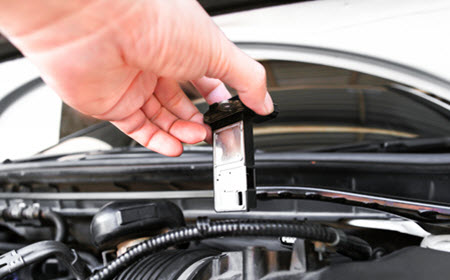
Which airflow codes show up on a Mercedes, and what does each one point to?
The five generic MAF codes — P0100 through P0104 — each describe a different kind of fault.
Reading them as one interchangeable group throws away most of their diagnostic value (and they aren’t the only airflow-related codes — manufacturer-specific ones extend the list):
- P0100 – circuit malfunction: A general fault in the MAF circuit. The sensor, its connector, wiring, and power or ground supply all belong in the diagnosis.
- P0101 – range/performance: The signal is present, but the reported airflow doesn’t agree with the expected operating range. Intake leaks live here, which makes this the code most tempting to pin on a dead sensor.
- P0102 / P0103 – low or high input: The signal has dropped below or climbed above its plausible window. Sensor faults, wiring and connector damage, and supply or ground problems all belong on the list before the sensor is condemned.
- P0104 – intermittent: The fault comes and goes — a loose connector, a chafed harness, or a sensor that only misbehaves at certain temperatures can all cause it.
Lean codes may appear alongside an airflow fault — P0171 for bank 1, P0174 for bank 2. On applicable M276 and M278 bi-turbo configurations with separate MAF sensing for the two intake paths, a one-bank lean code helps narrow which side to inspect — it doesn’t name the failed part, but it makes replacing both sensors on principle a poor move.
Why cleaning a Mercedes MAF sensor usually isn’t the fix
Cleaning removes contamination, but it cannot restore a sensing element that has already drifted out of calibration.
The internet’s standard advice — pull the sensor, spray it with MAF cleaner, put it back — is popular because it’s cheap and sometimes appears to work. Whether it actually helps depends entirely on which problem you have:
- Contamination: Cleaning can genuinely help — but if the source of the contamination is still upstream, the deposit and the symptom both come back.
- Drift: An element that has drifted out of calibration doesn’t clean back to spec. No solvent restores accuracy.
- Handling damage: The sensing element is delicate; contact, the wrong solvent, or improper cleaning methods can ruin it — and on some Mercedes applications it’s sold as an assembly with its housing, an expensive mistake.
If cleaning is the right call, it should be the conclusion of a diagnosis — not the first guess.
What actually gets on the sensor in the first place?
On many MAF-equipped Mercedes engines the sensor sits downstream of the air filter at the airbox outlet, collecting whatever gets past it.
The classic contaminant is oil, and one route in is the crankcase ventilation system rather than the filter side. A failing breather diaphragm can draw oil-mist-laden crankcase vapor into the intake, where it settles on the sensing element — and depending on the failure mode, the same fault can admit unmetered air at the same time: contamination and an intake leak from one part.
An aftermarket oiled cone filter that’s been over-oiled during service can do it too. Excess oil migrates downstream and coats the element in a film that’s hard to see and very effective at skewing the reading. Neither problem is fixed by replacing the sensor — the ventilation fault or filter needs correcting, which is ordinary Mercedes engine repair work.
How does a hot-film sensor measure air, and how does contamination skew it?
It reads the temperature pattern across a heated membrane — and deposits on that membrane distort the pattern.
Mercedes uses a hot-film mass air flow sensor, commonly abbreviated HFM. Inside is a small heated membrane with temperature-sensing fields on either side of its heating zone. With no airflow, the temperature pattern across the membrane is symmetrical; moving air disturbs it, cooling the upstream side while the downstream side stays warmer. The electronics convert that temperature difference into the air-mass figure the ECU fuels from.
Oil or dust on the membrane changes how heat moves across it, and that can bias the reported airflow. The signal may read low — pushing the mixture lean — or otherwise fall out of its expected relationship with actual airflow, affecting mixture control and potentially setting airflow or mixture faults. Either way the engine ends up fueled for a number that isn’t real, which is why contamination and an intake leak can feel identical from the driver’s seat.
How we isolate a Mercedes MAF fault instead of guessing
The goal is to prove whether the fault is the sensor, unmetered air, or something else before anything is ordered or removed.
That takes four steps, and skipping one is how a diagnosis becomes a guess with a receipt attached. It’s the same measure-first diagnostic methodology we apply shop-wide, and on a MAF complaint it runs the same sequence every time:
At the end of it there’s an answer with evidence behind it, and the repair follows the evidence. Sometimes it’s the sensor; sometimes it’s a cracked duct that a new sensor would never have fixed.

If your Mercedes hesitates, idles rough, or has been pulling airflow codes, we’ll find what’s actually causing it before anything gets replaced — and show you the data we used to decide. Motronix has been servicing Mercedes owners across Fort Lauderdale, Hollywood, Miami, and the greater South Florida area since 1988.
Related Mercedes Reading
- Mercedes Check Engine Light Guide: Common Causes and What to Check First — what the other frequent triggers are when the light comes on.
- Mercedes M274 & M264 Turbo Wastegate Failure: Early Signs of Boost Loss Most Owners Miss — another cause of the flat-midrange feeling described above.
- Mercedes Fuel Pump Failure: The Silent Signs of a Failing Pump on M274, M276 & M278 Engines — when hesitation is a fuel-delivery problem rather than an airflow one.
- Automotive Diagnostic Methodology — how real diagnostics works: the measure-first reasoning behind every job.
- Vehicle Maintenance Strategy & Service Intervals — how to set service intervals that catch wear items before they become faults.
Mercedes MAF Sensor Problems — Frequently Asked Questions
Can I keep driving my Mercedes with a suspected MAF sensor problem?
Why did my symptoms come back after a new MAF sensor was installed?
Should I clean the sensor myself before bringing the car in?
What else causes the same symptoms as a bad MAF sensor?
Technical References
- California Air Resources Board — what the OBD II system monitors and how detected malfunctions are flagged and stored: On-Board Diagnostic II (OBD II) Systems Fact Sheet.
- Robert Bosch GmbH — hot-film air-mass meter product documentation covering operating principle and application: Hot-film air-mass meter.
- Robert Bosch GmbH — Bosch Automotive Handbook, sections covering air-mass measurement, engine load calculation, and mixture control.
- Mercedes-Benz factory technical information (XENTRY / dealer service documentation) — airflow specification values, guided tests, and fault-code definitions.
- SAE International — SAE J2012 (Diagnostic Trouble Code Definitions) and SAE J1979 (E/E Diagnostic Test Modes), the OBD-II standards defining the P0100-series codes and the freeze-frame and fuel-trim data used in airflow diagnosis.