
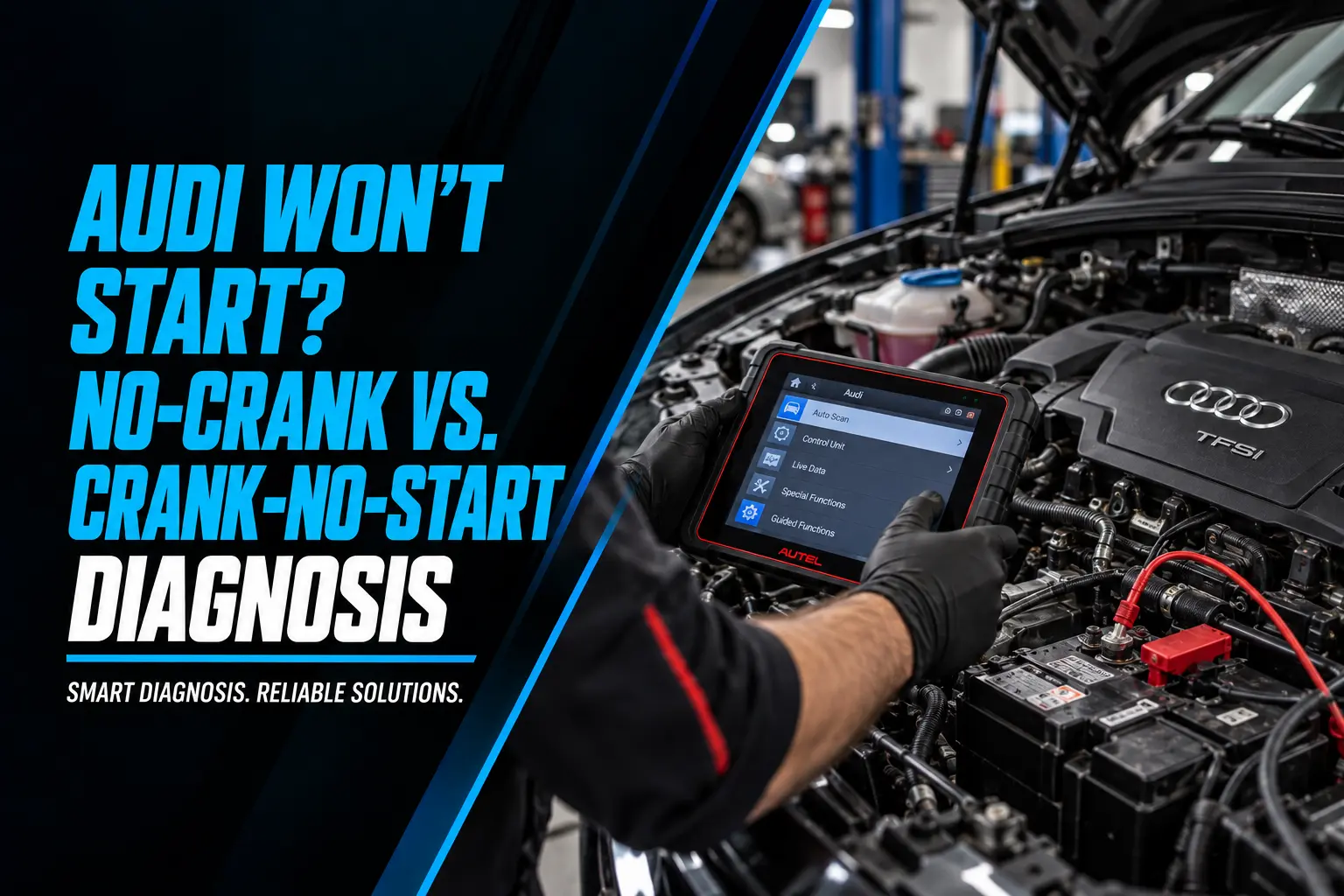
You press the start button and your Audi won’t start. Maybe you hear a click, maybe the dashboard goes dark, or maybe the engine turns over but never fires. Those symptoms may seem similar, but they point us toward different problems.
We hear both from Audi owners around Fort Lauderdale who bring their cars to us for Audi service.
- Listen first. No sound or one click is a no-crank; an engine that spins but won’t fire is a crank-no-start. Different causes, different tests.
- Start with the battery. A weak battery is one of the most common causes of an Audi that won’t crank, even when the dashboard still lights up.
- Audi’s start-authorization system can block cranking with a healthy battery. Key recognition, the immobilizer, and the transmission’s selector-position signal all have to agree before the starter engages.
- Crank-no-starts are usually fuel, spark, or a position sensor. Long-crank fuel-pressure patterns on the 2.0T have their own guide.
- Test before replacing. Battery and starter-circuit testing, a full-system scan, and targeted checks based on whether the engine cranks confirm the cause.
- Don’t keep cranking. Repeated attempts on a weak battery or an engine that isn’t catching make the next step harder.
What’s the difference between no-crank and crank-no-start on an Audi?
No-crank means the starter never turns the engine. Crank-no-start means the starter turns the engine, but combustion never catches.
A no-crank and a crank-no-start call for different tests. That’s why one of the first things we ask — even before the car arrives — is whether the engine actually turns over:
- No-crank — nothing or a click. You press start and the engine doesn’t rotate — silence, a single heavy clunk, or rapid clicking, and the dash may dim or go dark. We check the battery, the starter circuit, and the systems that authorize starting.
- Crank-no-start — engine spins but never fires. The starter works at its normal pace and the dash stays lit, but the engine never catches. Fuel, spark, and the engine-position sensors are what’s left to check.
- Slow, labored crank. The engine turns over sluggishly and may or may not catch. We investigate it on the battery and starter side first, since that’s where it usually leads.
Settling that question is the first step of any Audi diagnostic visit for a no-start, because it decides which tests matter.
How does a shop confirm what’s keeping an Audi from starting before replacing parts?
Battery voltage, starter current, and a full-system scan give us a useful starting point. From there, we test the circuits or systems the results point toward.
The load test and the scan answer different questions. A battery can show normal voltage when the car is off but still fail when the starter puts it under load, so we test it under the conditions that matter, not just with a quick voltage reading. The scan tells us whether any system actively declined the start request. Those two results together help us tell a battery problem from a starting-system fault.
- Confirm whether it cranks. Everything after this depends on that answer.
- Battery, starter, and charging-system checks. Battery voltage, voltage drop through the starting circuit, and starter current draw when appropriate. This tells us whether the battery and its connections are supplying enough power before we look at anything else.
- Scan every module. Engine, transmission (for selector-position faults), start authorization, and the body and access-control modules. A refusal logged in the transmission module can look like a battery problem if only the engine module is read.
- Inspect grounds, terminals, and the starter circuit. Corroded terminals and tired ground straps can produce a no-crank with a battery that tests close to spec. Grounds are the return path for everything on the car, so we voltage-drop test them rather than trusting a visual inspection — the reasons are on our automotive electrical system architecture page.
- Fuel, spark, and engine-position signals (crank-no-start only). We let the codes and live data decide the order — fuel pressure when the symptoms point at delivery, engine-speed signal during cranking when the scan shows none.
We start with the basic checks that narrow the problem quickly, then move into more detailed testing where needed.
What should I check at home before booking an Audi no-start diagnostic?
You probably can’t fully test the battery at home, but a few observations help us narrow things down before the car arrives.
- Listen, then describe it. Silent, one click, rapid clicking, or an engine that spins without catching? That one answer tells us where to start before the car arrives.
- Try the emergency key-recognition procedure. If the car reports that the key isn’t detected, your owner’s manual shows where to hold the fob — the spot varies by model and year. If it starts that way, check the key-fob battery first, though other key-detection problems are possible.
- Shift to Neutral and back to Park, then try again. Keep your foot on the brake and follow your owner’s manual. If the car suddenly cranks, the selector-position signal is worth checking — book the diagnostic anyway.
- Watch the headlights during the attempt. Lights that dim noticeably while cranking are a clue toward a weak battery or a bad connection. Lights that stay bright don’t rule a battery out, but they shift our attention elsewhere.
- Note any warning that came on just before. An EPC light, a battery or charging symbol, or a key symbol each point us somewhere different, and your memory of what you saw is often the most useful piece of the diagnosis.
Why does my Audi click but not crank, or do nothing at all?
A no-crank usually comes from one of three places: the battery and charging system, the starter path, or an electronic system preventing the car from starting.
We usually check the battery and its connections first because they’re common causes and relatively straightforward to test.
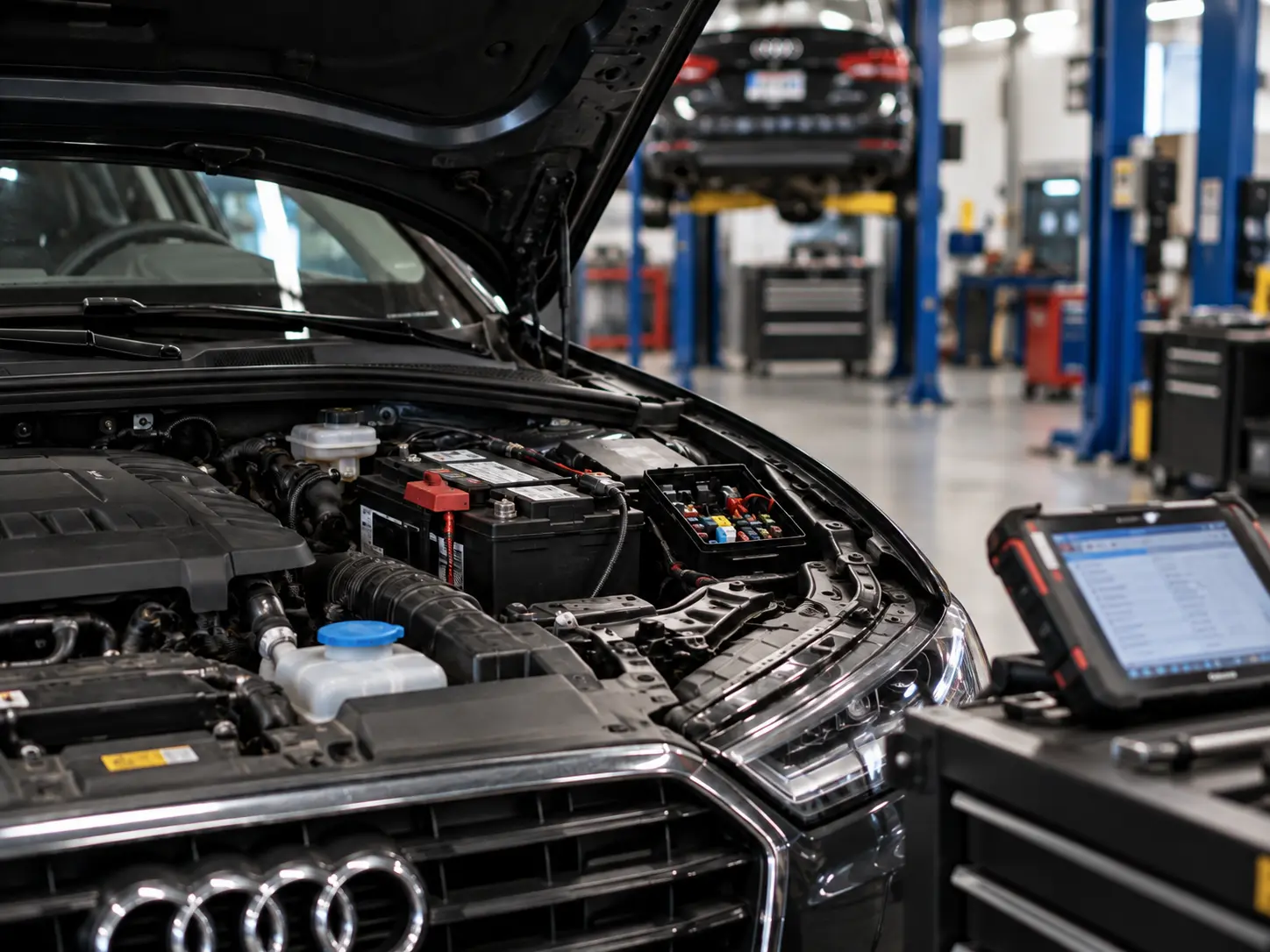
- Battery and charging system — the usual answer. A battery that is weak at rest can light the dash and still fail under the starter’s current draw. A corroded ground strap or loose battery terminal can cause the same symptoms as a weak battery, so we check the connections as well as the battery itself. Many modern Audis also require battery registration after replacement; skipping that step can affect the car’s energy-management strategy and contribute to premature battery wear or charging-related complaints. The loaded test, the grounds and terminals, and the coding step are the first things we check during an Audi battery and electrical service visit. For what South Florida heat does to a battery in the first place, see our European car battery guide.
- Starter and its wiring path. If the battery tests good, we check power, grounds, and the starter’s control signal before replacing the starter. A wiring or connection problem can produce nearly identical symptoms.
- Audi start authorization. Key recognition and the immobilizer, plus the transmission’s selector-position signal, can each refuse the start request with a healthy battery and a healthy starter.
A refused start can look just like a dead battery at the button; the two below are the Audi-specific ones.
Which Audis are prone to immobilizer or anti-theft lockouts that block starting?
Any current Audi. The car has to recognize and authorize the key before it will start, and when that process fails the car can refuse with the battery and starter perfectly healthy.
When key recognition fails, the car might do nothing when you press the button, show a key warning, or crank without starting; some immobilizer systems can also let the engine start briefly before shutting it down. The exact symptoms depend on the model and what’s gone wrong. They point toward key recognition or start authorization rather than a failed starter, but we still check the battery and electrical supply before ruling those out.
On models like the A4, A5, Q5, A6, and Q7, we look for a few possible causes:
- Dying key battery. The most common cause we see, and the easiest to miss. The emergency key-recognition procedure in the owner’s manual (the location varies by model and year) usually lets the car read the transponder. If it starts that way, the key battery is the first thing to check.
- A spare or replacement key that was never adapted to the car. A replacement key that hasn’t been properly programmed or adapted to the car may operate some functions without being authorized to start the engine.
- Interference from another fob or a wallet of RFID cards. Uncommon, but it happens with push-button start. Separating the Audi key from everything else and trying again takes ten seconds.
- Immobilizer or antenna faults. Less common. These may store faults in the access, body, or engine-management systems, so we check the relevant modules and live authorization data to narrow it down.
None of this looks like a battery or starter problem from the driver’s seat, which is why we check the simple possibilities first, starting with the key battery.
Can a transmission or shifter fault stop my Audi from starting?
Yes. Some Audi models refuse a start request when the transmission or selector-position system doesn’t report an acceptable starting condition, even with the battery and starter healthy.
Depending on the model, the starting system has to recognize an acceptable transmission position — generally Park or Neutral — from an electronic signal rather than a mechanical linkage. If that signal is missing or implausible, because of a selector fault, a range-sensor problem, or a related electrical issue, the car may block the start even when the shifter is physically in Park.
What this often looks like from the driver’s seat:
- Foot on the brake, shifter in Park, nothing happens. The dash is bright and the battery is fine, and the button does nothing.
- Moving the shifter makes it crank. Shifting to Neutral and back to Park, or nudging the selector, sometimes restores the signal long enough to start. That’s a useful clue, not a diagnosis.
- Intermittent at first. Some owners notice only an occasional refusal that gets more frequent, with or without a selector warning in the cluster.
We check the transmission and start-authorization data before assuming the starter has failed. The fix depends on what the scan shows: sometimes an adaptation or software update, sometimes a sensor replacement, sometimes a selector-module repair.
Why does my Audi crank but not fire?
When the starter is working and the engine is spinning, the problem is usually fuel delivery, spark, or a sensor fault that keeps the engine computer from calling for a start.
We start by checking fault codes and live data. From there, we test fuel pressure, ignition, or engine-position signals depending on what we find:
- Fuel delivery. Inadequate low-pressure supply, trouble building enough high-pressure fuel, or a fault in the controls that run the pumps. We measure actual pressure during starting rather than relying on whether anyone heard the pump. On some 2.0T engines, recurring long starts can be associated with high-pressure fuel-system problems; our Audi 2.0T HPFP guide covers that failure.
- Spark and ignition. A single failed coil typically causes a misfire rather than a complete no-start. If there’s no spark at all, we investigate the ignition power supply, its controls, and the related sensor signals.
- Crankshaft- and camshaft-position sensors. The engine computer relies on crankshaft and camshaft signals to coordinate ignition and fuel injection. Depending on the fault, a missing or unreliable signal can cause extended cranking, intermittent starting, or a complete no-start. These faults may store a code, but we also watch live sensor data and the engine-speed signal during cranking to confirm it.
Those results help us narrow the problem without replacing parts unnecessarily.
When is an Audi no-start urgent, and what should I NOT keep trying?
An Audi that won’t start while safely parked usually isn’t an emergency, but it’s worth diagnosing before making more attempts. If the car stalled while driving or you’re stranded somewhere unsafe, treat it as urgent. Slower and slower starts over several weeks are the car warning you before it strands you.
Is a slow-starting Audi in South Florida heat about to leave me stranded?
If the slow starts began this summer and haven’t gone away, treat it as a warning that the battery may be deteriorating — a load test shows whether it’s still performing within spec.
We see this fairly often on Audis here in South Florida, especially after several summers of heat: the battery starts behaving differently. It might start a little slower than usual, or the automatic start-stop system may stop working as often. Then one morning it takes several tries to start. The owner assumes it’s nothing because the car eventually started, but those can be early signs of a weakening battery.
Those can be warning signs that the battery is nearing the end of its life. The battery may still start the car, but it can have less reserve capacity or cranking capability than it once did, and a few days of sitting can be enough to expose that. A load test and charging-system check can show whether the battery is still performing within specifications or becoming unreliable. They can’t predict exactly when it will fail, but they can tell you whether replacement is advisable.
Two things we’d tell any South Florida owner in that spot: don’t drive through more than one or two odd starts without getting it tested, and don’t let the car sit for days in the heat without having driven it recently.
Either way: stop cranking, note what the car did, and get it tested.

Having trouble starting your Audi? Whether it clicks, cranks without starting, or is getting slower to turn over, we can track down the cause. We test the battery, starting system, and related electronics before recommending repairs. Motronix in Dania Beach serves Audi owners from Fort Lauderdale, Hollywood, Miami, and across South Florida. Call or schedule below.
Related Audi Reading
- Audi 2.0T HPFP Failure — the long-crank fuel-system side in full.
- Audi S-Tronic (DSG) Transmission Problems — the transmission behind the selector-position interlock.
- Audi EPC Warning Light — if a cluster warning preceded the no-start.
- European Car Battery Failure in Hot Climates — why Florida heat shortens battery life.
- Audi Transmission Malfunction Warning — if a selector or gearbox warning preceded the no-start.
- Automotive Diagnostic Methodology — symptom to confirmed cause.
Frequently Asked Questions — Audi No-Start
My Audi makes one click and won’t crank — is it the battery or the starter?
Often the battery, but not always. Lights that dim or flicker with the click point toward the battery or its cables; lights that stay bright point toward the starter, its control signal, or the car’s start-authorization system. A loaded battery test and a check of the starter circuit settle it — a new starter changes nothing when the real fault is a weak battery or a corroded ground.
My Audi cranks but won’t start — do I need a new fuel pump?
Not necessarily. Fuel pressure, spark, and the crank- and cam-position sensors are the main possibilities, and only one of them is a pump. A full-system scan narrows it quickly, and we confirm with live data and a fuel-pressure measurement before condemning a pump.
Why does my Audi refuse to crank with my foot on the brake and the shifter in Park?
Some Audi models block the start when the transmission’s selector-position signal doesn’t report an acceptable position. If moving the shifter to Neutral and back to Park lets it start, that’s a useful clue; the scan confirms whether a selector or range-sensor fault is behind it.
Can a dying key fob battery stop my Audi from starting?
Yes, and more often than owners expect. If the car reports the key isn’t detected, use the emergency key-recognition procedure in your owner’s manual — the location varies by model. If it starts that way, check the fob battery first, though other key-detection faults are possible.
Can a brake-pedal switch stop my Audi from starting?
Yes, on a push-button Audi the car has to see the brake pedal pressed before it will authorize a start. If the brake-pedal switch or its signal fails, the car may do nothing when you press the button — with the battery and starter perfectly healthy. We can check whether the car is seeing the brake-pedal signal in live diagnostic data, which is one more reason we read every module before replacing anything.
Does Motronix diagnose Audi no-starts, or do I need the dealer?
Yes. We use factory-level scan equipment, a loaded battery and starter current test, and a fuel-pressure check — the same framework a dealer uses, at an independent shop in Dania Beach. Call us with the symptom you heard; if the car won’t start at all, tell us so we can plan around a tow.
Technical References
- Battery University — BU-905a: Testing Starter Batteries in Vehicles — heat-related starter-battery failure, rising internal resistance, and labored cranking.
- AAA — Summer Heat Kills More Batteries Than Winter Cold — sustained heat as the leading cause of battery failure, and the warning signs owners can watch for.
- Bosch Automotive Handbook (Robert Bosch GmbH) — starting systems, starter batteries, and battery-testing fundamentals.
- Audi factory technical information (ODIS / ELSA dealer service documentation) — immobilizer and start-authorization chain, S-tronic park-lock and selector-position sensing, and battery replacement and registration (coding) procedures.
- Battery Council International (BCI) — Battery Service Manual — battery specification standards and load-test procedures.