
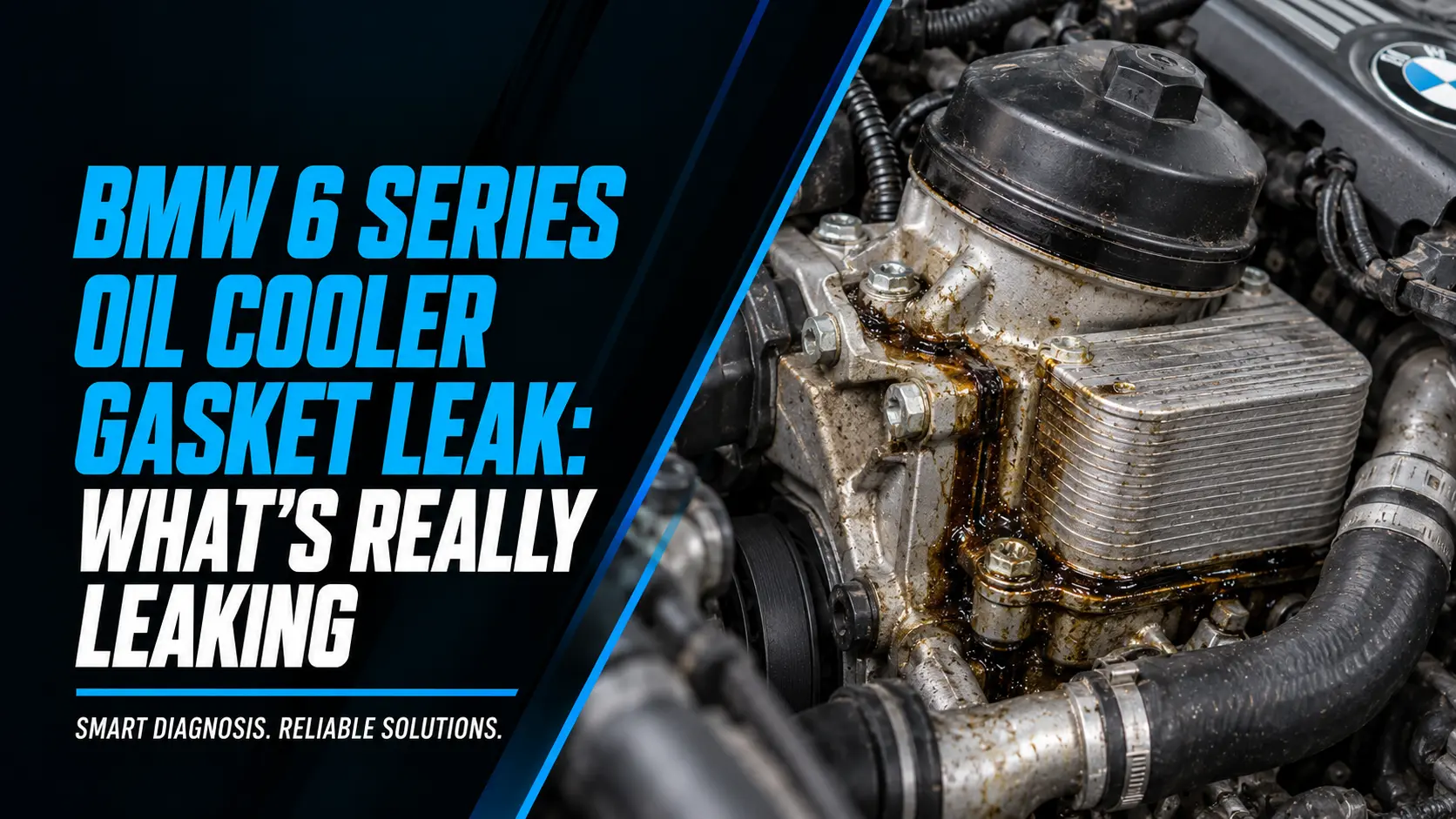
A pattern we see often on the BMW 6 Series: a hot, acrid smell a few minutes after parking, a low-oil message on a car that was fine last month, and a clean driveway. The words that come back from the first shop are usually “oil cooler gasket.”
Sometimes that’s right. Often it isn’t — because “the 6 Series” is three generations and four engines, and the part behind that complaint isn’t the same in any two of them. As an independent BMW specialist in the Fort Lauderdale area, here’s how we work out which one you actually have before anything gets ordered.
- “Oil cooler gasket” names several different sealing points. The answer changes across the N62, N55, N63 and B58 — and on some, with the car’s exact cooling equipment.
- On the older N62 V8, suspect the alternator bracket. It seals an oil passage at the block, and on cooler-equipped cars the cooler circuit meets it there.
- On the N55 640i it’s the familiar two-gasket housing. What the outer gasket seals there depends on which cooling setup the car was built with.
- A clean driveway is not good news. The undertray can hold the leak above the ground, so the smell often arrives before any drip does.
- The wet spot is the worst place to start. Oil runs down and back, so it arrives wettest where it leaves, not where it started.
- On the N55, the belt is the reason not to wait. Oil onto the crank pulley can take the serpentine belt with it — far worse than the gasket.
Does my BMW 6 Series even have an engine oil cooler?
Not necessarily — and on the older V8 cars the fitment is narrow enough that it has to be established per car rather than assumed.
BMW tied engine oil cooling to the engine and the drivetrain rather than the model badge, and the fitments get specific fast — BMW’s own parts listing for the Genuine N62 engine oil thermostat narrows it to 550i and 650i cars with the six-speed manual. The 4.4-liter N62 in the 645Ci and the 4.8 in the 650i aren’t identically equipped either. Two cars that look the same in a parking lot can carry different hardware.
So a shop quoting “oil cooler gasket” without looking the car up is guessing at a part, and that guess is wrong often enough here to be expensive. Most of the BMW oil leak repair we do starts by undoing that assumption, because oil turns up a long way from where it started and the part nearest the puddle gets named first. We look the car up by VIN before anyone talks about a gasket.
If it isn’t the oil cooler gasket, what is actually leaking on a 6 Series?
Four engines, four different answers — and yours depends on which generation you’re driving.
In the US market the 6 Series covers three modern generations. Placing yours narrows the list from “everything at the front of the engine” to two or three parts:
- 645Ci (2004–2005) and 650i (2006–2010), E63/E64, N62 V8: The alternator bracket seals an oil passage at the block face, and on cars fitted with the engine oil cooler the cooler circuit meets it in the same area. Either way it’s the classic front-of-engine leak here — and oil coats the alternator on the way down, which is why it so often gets called an alternator problem instead.
- 640i, F06/F12/F13 (2012–2018), N55 turbo six: This is the familiar two-gasket oil-filter-housing setup — the one most people picture when they say “oil cooler gasket.” The inner gasket seals the housing to the engine; the outer one seals either an oil-to-coolant heat exchanger or the thermostat unit for a separate oil cooler, depending on how the car was configured.
- 650i, F06/F12/F13 (2012–2018), N63 V8: Don’t carry the 640i’s layout across. On the N63, BMW accommodates the oil filter housing in the oil pan, reached from below — there’s no front-mounted filter-housing gasket here to blame. Oil showing higher up or at the side of the engine has to be traced to its real source rather than assumed.
- 640i xDrive, G32 6 Series GT (2018–2019), B58: The only 6 GT sold here, and it does not share the earlier 640i’s housing. The B-series carries its own integrated oil-filter module, housing and oil/coolant heat exchanger in one assembly with its own gasket sets, so F-chassis part numbers and leak patterns don’t transfer. Our BMW oil leak guide maps the B-series sources one by one.
This guide covers the 645Ci, 650i and both 640i generations. The M6 variants use different engines again and aren’t covered here.
Why does an N62 645Ci or 650i oil leak trace back to the alternator bracket, and cost so much more than the gasket?
Because on the N62 the alternator bracket seals an oil passage at the block — and it’s buried behind the alternator and an engine mount.
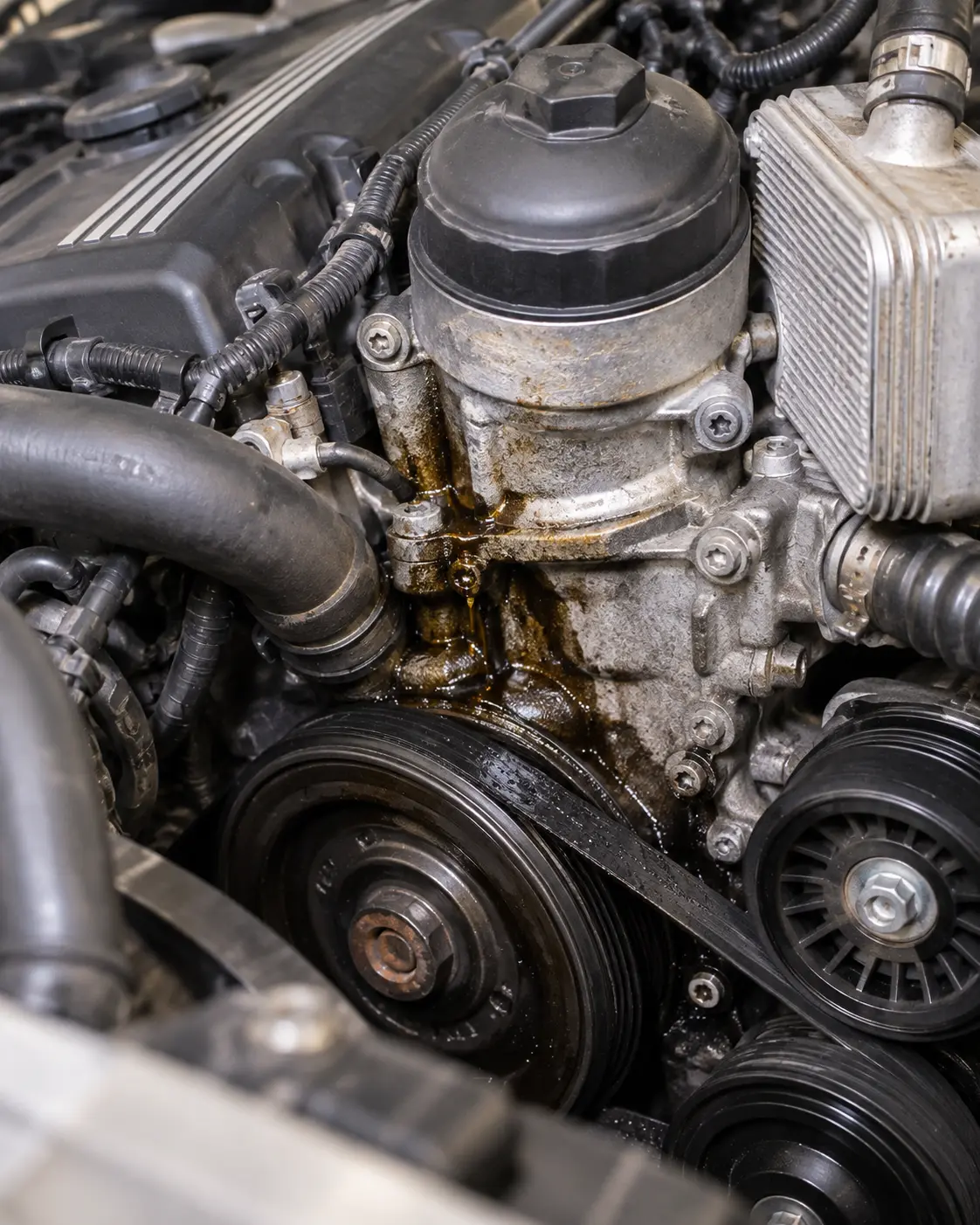
The bracket bolts to the front of the block and carries an oil passage through it. On cars fitted with the engine oil cooler the cooler lines land in that same area through their own seals — which is why BMW lists a different bracket gasket for cooler-equipped cars, that version having to separate the feed and return openings. So depending on equipment, the casting is the alternator mount, sometimes the oil-cooler take-off, and the thing that leaks. When the seals harden, oil escapes at the block face and runs down the front of the engine, onto the alternator, along the lower edge of the block and onto the undertray — so every visible clue points somewhere other than the bracket.
The gasket itself is small and inexpensive. Reaching it is not: the alternator comes off, the engine gets supported, and the mount comes down. That’s why this one is quoted in hours rather than by the part, and why it’s worth doing the oil cooler line O-rings and any other seals in that area while it’s apart. It’s also why the diagnosis carries weight here: the vacuum pump sits higher on the front of the cylinder head and can contaminate the same area, so committing to this teardown on a hunch can mean substantial work for the wrong seal. We verify the source before authorizing it.
Why can a heat-exchanger-equipped N55 640i leak coolant as well as oil?
On heat-exchanger-equipped N55 640i cars, the outer of the oil filter housing’s two gaskets seals a junction carrying both fluids at once — but not every car is built that way.
On the N55 the inner gasket seals the oil filter housing to the engine — oil only. The outer one — BMW part 11428637820, the gasket for the heat exchanger or oil-cooler thermostat unit that sits in front of the oil filter housing — is an Elring part, Elring being BMW’s original supplier for it. Which setup your car has changes the answer, so it’s worth knowing that BMW built the N55 with two oil-cooling arrangements. One bolts an oil-to-coolant heat exchanger to the filter housing. The other — BMW’s own “hot climate” version — deliberately keeps engine oil out of the coolant circuit and uses a separate oil-to-air cooler instead. On a heat-exchanger car, a failure at that seam can show as oil, coolant, or both. On a hot-climate car there’s no coolant at that junction to lose. We establish which one the car has rather than assuming it.
So on a heat-exchanger 640i, an unexplained slow coolant loss and an oil weep at the same corner of the engine are worth mentioning in the same breath when you book — they may be one repair. The coolant side of this junction on BMW’s newer B-series engines is the subject of our BMW B58 and B46 coolant leak guide. Replacing one gasket and not the other is a common way to do the job twice.
What does a 6 Series oil leak look like from the driver’s seat?
Often a smell before a puddle — because the undertray can hold the leak above the ground.
The undertray works like a drip pan: oil collects there and bakes off against the exhaust instead of reaching the ground, so the stain the old advice tells you to look for is often the last thing to appear. These are the signs that show up before it, roughly in the order owners tend to notice them:
- A hot, acrid smell a few minutes after parking: Oil on a hot exhaust component burns off rather than dripping, and the smell peaks once the car stops and airflow through the bay stops with it.
- A thin haze off the back of the engine bay: Often at a red light after a longer drive, and easy to dismiss as heat shimmer the first few times.
- Oil needing topping up between services: On the F-chassis 640i and 650i there’s no dipstick — level is read electronically through iDrive, engine warm, car level. A slow leak won’t necessarily trigger a low-oil warning, so a normal reading doesn’t rule it out.
- Film building on the undertray: Often the first thing actually visible, and worth leaving exactly as it is — the pattern on the tray is evidence.
If you’re adding a liter between services on a car that never used to want any, that’s your signal — floor stain or not.
Why does tracing the wet spot yourself usually land on the wrong part?
Because oil doesn’t fall straight down — it runs along castings and back along the underside, arriving wettest where it leaves rather than where it started.
The old advice — get under the car, look for dampness near the cooler and the hoses — sounds reasonable and fails for a specific reason. The front of an N62 stacks several independent sealing points at different heights, and oil from any one can pass over everything beneath it on the way down:
- Valve covers, highest: A weep here runs the full height of the engine before it reaches anything visible from underneath.
- Vacuum pump, front of the cylinder head: Sits above the exhaust-manifold area, where a leaking pump seal can produce a strong hot-oil smell.
- Alternator bracket and oil-cooler connections, mid-engine: The classic source — and the one that soaks the alternator on its way past and gets blamed on it.
- Oil pan and its lower edge, bottom: Collects everything above it, which is exactly why it looks like the most convincing candidate.
So what you can see from a driveway may be several castings downstream of the actual seal.
How do we confirm which gasket is leaking before any parts are ordered?
The car goes on a lift, the underside gets cleaned, and the leak is traced back to its origin rather than inferred from where the oil ended up.
The sequence is deliberate. The tray comes off and the front of the engine is degreased, because tracing a leak through a decade of accumulated film tells you nothing. Then the car is run to temperature and driven — a leak that only opens when hot looks dry on a cold car, which is exactly when an owner can get under it. Sometimes a clean engine then shows the source on its own; when it doesn’t, UV dye in the oil makes the trail readable. Either way it’s followed back to its origin rather than condemning the lowest or wettest component.
Why that order matters: a wet part is not a failed part. On a car that’s been weeping for a few years we often find more than one seal involved. So before we quote an alternator-bracket reseal on an N62, we want the trail to originate at the bracket sealing surface — not simply to pass over it on the way down from the vacuum pump or the valve covers. We assess those upper seals on the same visit rather than bringing the car back for another leak a month later.
Where oil and coolant share a junction, as on a heat-exchanger-equipped N55 640i, the coolant side gets pressure-tested in the same visit rather than assumed, and stored fault codes get read for low-oil-level and oil-level-sensor faults. For the actual rate of loss the most useful history is still yours: how much oil you’ve added and over how many miles. It’s the same BMW factory diagnostic scan we’d run on any front-of-engine complaint: slower than pointing at the wettest part, and the difference between replacing one gasket and replacing three.
How urgent is a BMW 6 Series oil leak, and can it start a fire?
On the N55 640i, belt contamination is the bigger mechanical risk; on any of these engines, oil reaching hot exhaust components deserves attention on its own.
Oil onto a hot exhaust component is what produces the smell and the haze, and a persistent leak onto one is a genuine fire risk rather than a theoretical one. On the 640i’s N55 there’s a second path: oil escaping the filter housing area can drip onto the crank pulley. FCP Euro’s technical write-up on oil filter housing leaks across the N51, N52, N54 and N55 sets out what can follow: the belt slips off the pulley, wedges between pulley and block, shreds, and is drawn through the front crank seal into the engine. It isn’t the common outcome, but it is a documented one. Once belt material is inside the engine, the repair is no longer comparable to a gasket replacement.
A small seep that isn’t reaching the belt drive or a hot exhaust component, and isn’t costing measurable oil, can usually wait for a scheduled appointment. Oil reaching the belt drive, a level that’s actively dropping, or visible smoke all deserve prompt inspection instead — and our oil leak diagnosis and seal integrity reference covers where that line sits by source.
What does the repair involve on each 6 Series generation?
The seals themselves are inexpensive in most of these repairs. What separates the jobs is how much has to come apart to reach them.
What that means in practice differs by engine:
- N55 640i: The intake manifold comes off to release the oil filter housing, and both gaskets go in together — doing the inner and leaving the outer is how this job comes back. What’s attached to the housing depends on the car: an oil-to-coolant heat exchanger on some, a thermostat and separate cooler on hot-climate cars.
- N63 650i: Doesn’t share that layout at all. Its filter housing sits in the oil pan and is reached from below, so a front-of-engine leak gets scoped only once the source is confirmed.
- G32 B58: A different integrated oil-filter and heat-exchanger module again, so its gasket set and access procedure are specific to the B-series assembly, not the earlier N55 housing.
- N62 645Ci and 650i: The outlier for access — the alternator comes off and the engine mount comes down to reach the bracket, which is why this one is quoted in hours rather than by the part.
Two service rules apply wherever they’re relevant. Any coolant circuit that gets opened is refilled and bled. And when a repair interrupts the engine-oil supply circuit — removing an oil filter housing or an engine oil cooler, for instance — BMW specifies an oil-pump priming procedure before normal operation. Skipping that step can cause oil-starvation damage.
Across all of them we fit OEM and OE parts — never anything below OE quality — and the work carries our 24-month/24,000-mile parts and labor warranty on most repairs. A belt that’s been running in oil gets replaced, not wiped down; it’s the cheapest part of the job and the most expensive one to reuse. Anything past the sealing surfaces themselves moves into BMW engine repair territory, and we’d show you what we found before it went there.

If your 6 Series has started smelling hot after a drive or asking for oil between services, we’ll put it on a lift and trace the source before anyone quotes you a gasket. Motronix in Dania Beach has served BMW owners from Fort Lauderdale, Hollywood, Miami, and the greater South Florida area since 1988.
Related BMW Reading
- BMW Oil Leak Problems: Symptoms, Sources and Repair — the six-source map for B58, B48 and N55 engines, and how each source is separated from the others.
- Oil Leak Diagnosis & Seal Integrity — why European engines seal the way they do, and when a leak is urgent versus a monitoring item.
- Why Small Leaks Turn Into Big Failures — the difference between a seep, a drip and a loss, and which small leaks are high-risk even when the puddle is tiny.
- BMW Maintenance at 60k, 90k and 120k Miles — what a BMW actually needs at each interval in South Florida, and how to read a CBS service report.
- European Car Repair vs Replace: A Decision Guide — how labor overlap changes the math when one repair opens up access to another.
- Cooling System & Thermal Management — how engine oil and coolant circuits share heat load, and what happens where they meet.
BMW 6 Series Oil Cooler Gasket Failure — Frequently Asked Questions
How do I check the oil level on a BMW 6 Series if there’s no dipstick?
Does an oil cooler gasket leak mean my engine is overheating?
Can a leaking oil filter housing gasket ruin the serpentine belt?
I was told my alternator is leaking oil — is that even possible?
Should I just add oil and keep driving until I can book it in?
Technical References
- FCP Euro — Gareth Foley, technical guide covering oil filter housing gasket leaks on BMW N51, N52, N54 and N55 engines, including the serpentine-belt and front-crank-seal failure sequence and the intake-manifold access requirement on N54/N55: How To Fix A Leaky Oil Filter Housing On An N51, N52, N54, Or N55 Engine.
- BMW Tuning — editorial guide to the most common BMW N55 problems, including the oil filter housing / oil-cooler gasket leak, the oil-onto-belt failure sequence, and the risk of oil and coolant cross-contamination when the leak is left unaddressed: The 5 Most Common BMW N55 Engine Problems.
- BMW N55 Engine technical training material, Cooling System section — documents the two N55 oil-cooling arrangements: an oil-to-coolant heat exchanger bolted to the oil filter housing, and the “hot climate” version in which the oil cooler is separated from the engine coolant circuit.
- BMW N63 Engine technical training manual (initial print date 04/08), Engine Housing Components — states that the two-piece aluminum oil pan accommodates the oil filter housing, the architectural difference that separates the N63 650i from the N55 640i’s front-mounted housing.
- BMW Service Information bulletin SIB 11 02 20, “Engine Replacement And Engine Repairs — Oil Pump And Supply Circuit Priming Procedure” (supersedes SI B11 09 15) — specifies the priming procedure required after repairs that remove or replace components interrupting the engine-oil supply circuit, the engine oil filter housing and engine oil cooler among them.