
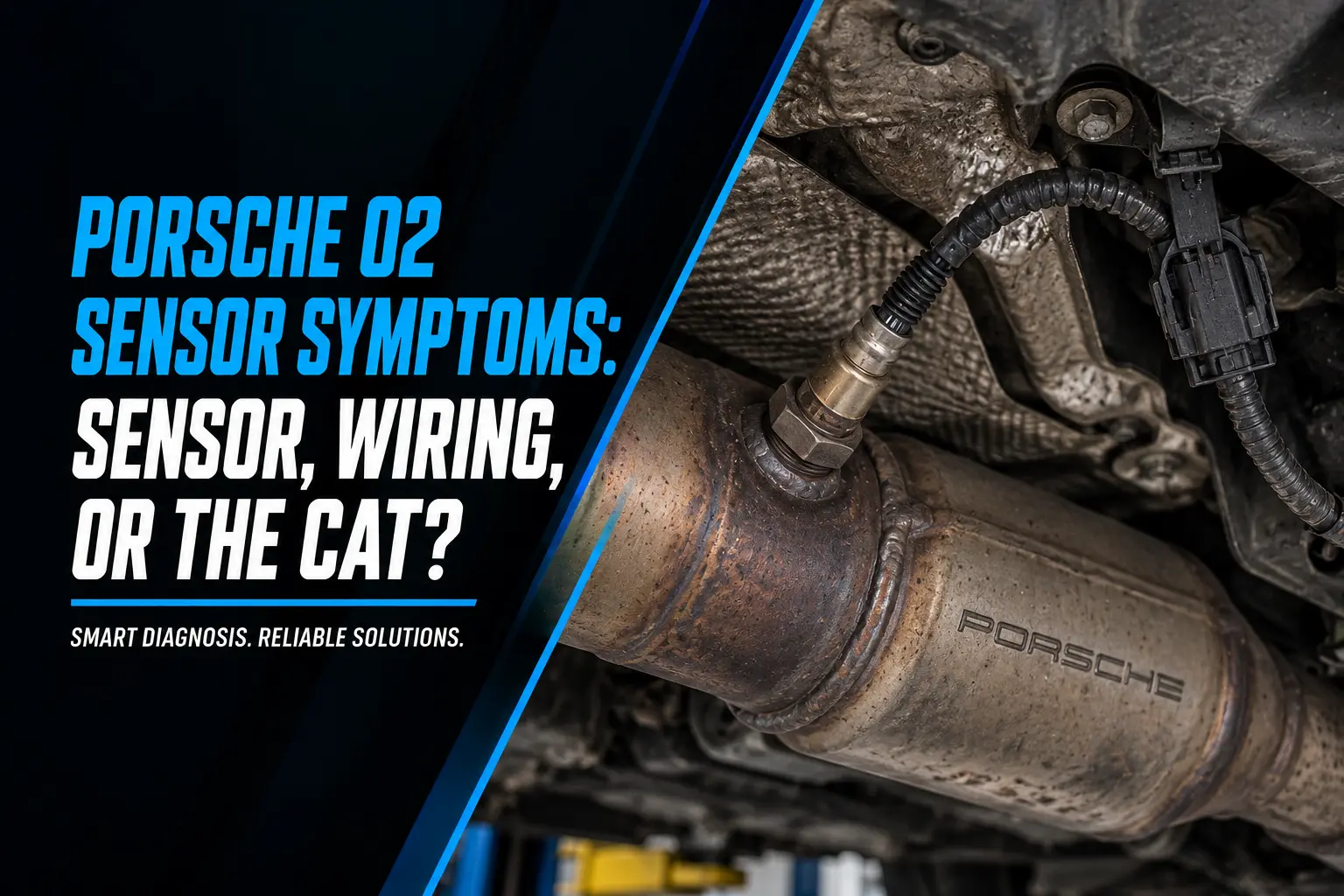
Most people land here because a scan tool put an oxygen sensor code in front of them, and the question underneath is whether a sensor needs replacing. The code says the engine failed one of its own tests — not which part failed it. On a Porsche there is more than one sensor, more than one circuit, and an exhaust that can set the same code with every sensor working properly.
We’re a Porsche specialist shop, and this is the version we’d give an owner standing in the bay with us: which sensor the code is actually pointing at, how urgent it really is, and why replacing that sensor so often leaves the light exactly where it was.
- There isn’t one sensor. Upstream and downstream sensors sit around the catalyst. The upstream one is the primary fuel-control sensor; the downstream one mainly grades the converter.
- The code names a failed test, not a failed part. An exhaust leak, a chafed wire or a rich-running engine can all set sensor codes with the sensor fine.
- Normal exhaust heat isn’t the problem. These sensors are built to run hot. Contamination, abnormal overheating, heater faults, wiring damage and age are what finish them.
- The expensive consequence is converter damage. A long-ignored rich-running condition is what puts a catalytic converter at risk.
- Florida has no emissions test. It ended in 2000, so this won’t block your registration — which isn’t the same as costing you nothing.
- Drivability sets the urgency. A stored code on a car that drives normally is a different problem from one stumbling or drinking fuel.
What are the symptoms of a failing O2 sensor on a Porsche?
Often the only noticeable symptom is a check engine light — and when there is more, it shows up in fuel economy and light-throttle drivability rather than anything dramatic.
- Check engine light, no change in how the car drives: Common, and what makes these faults easy to ignore while the car still drives normally.
- Fuel economy falling off: Often a gradual drop rather than a sudden one — the engine compensates continuously instead of failing outright.
- Rough idle or hesitation: Possible with an upstream sensor or mixture-control fault — though these particular symptoms have plenty of other causes.
- A fault most obvious during warm-up: Often the heater circuit. The sensor may start working once exhaust heat brings it up to temperature, but the heater fault stays stored and diagnosable.
Does an oxygen sensor code mean the sensor itself is bad?
No. It means the engine’s own monitoring found a reading it can’t reconcile — and several things other than the sensor produce exactly that.
Reading an oxygen sensor code as a bad sensor is one of the costliest misreads in Porsche diagnostics, and the mechanism is simple enough. The sensor measures the oxygen left over in the exhaust, and the engine works backwards from that to how rich or lean it is running — so several very different faults make that reading implausible. An exhaust leak ahead of the sensor draws in fresh air and reads as a lean engine. A connector fault reads as a sensor that stopped responding. A rich engine reads as a sensor stuck rich. The engine computer can often tell those patterns apart — a circuit fault, a slow response and a dead signal are separate codes — but the code still points at the sensor, because that’s where the reading came from.
So what actually makes oxygen sensors fail on a Porsche?
Contamination, electrical faults and age — plus abnormal heat, which is not the same thing as the normal heat these sensors are built for.
An oxygen sensor lives in the exhaust stream on purpose, and carries an internal heater specifically so it gets hot fast and stays hot, because it can’t read accurately cold. So normal exhaust temperature is not evidence of anything — it’s the design condition. Genuine thermal overload or thermal shock is a different matter and is a recognised way to damage one.
- Oil passing through combustion: The Porsche-specific one. When an air-oil separator diaphragm fails, oil mist goes into the intake and burns continuously, which can contaminate the oxygen sensors and, over time, reduce the effectiveness of the catalytic converter. A history of oil consumption or blue smoke on overrun needs settling before anyone buys sensors: replacing the sensor without fixing the oil source risks contaminating the replacement. Confirming an air-oil separator failure takes a specific set of checks, and the startup smoke that gives it away is easy to dismiss as nothing.
- Running rich for a long time: A leaking injector or a mixture fault loads the sensor with soot and shortens its life while the sensor is faithfully reporting the problem.
- Heater element failure: An electrical failure inside an otherwise healthy sensor, often detected during warm-up. The sensor may start producing usable data once exhaust heat brings it up to temperature, but the fault stays stored — and no amount of exhaust work addresses it.
- Wiring and connector damage: These sensors sit inches from the hottest part of the car. On the naturally aspirated flat-sixes we service we pay particular attention to harness routing near the exhaust, and we check the circuit before condemning a sensor.
- Abnormal heat: Not ordinary running temperature, but thermal overload, or thermal shock from raw fuel or moisture contacting a hot sensor. Coolant entering combustion is a separate route — it contaminates the sensing element rather than shocking it.
- Age and mileage: Sensors slow down gradually. One that still switches but switches late can set a response code long before it stops working.
Is it the sensor before the catalytic converter, or the one after?
They are not interchangeable, and it changes what the code is actually telling you.
Modern Porsche exhaust systems use an upstream sensor ahead of the catalyst and a downstream one behind it; the exact number and layout depend on the engine. The upstream sensor is the primary fuel-control sensor: it feeds the mixture correction second by second, and a fault there can affect mixture control, fuel economy and drivability. The downstream one mainly monitors the converter, comparing what goes in against what comes out — though some systems also use it to make a slow correction to the upstream sensor’s calibration.
So a front-sensor fault is much more likely to cost you fuel and drivability. A rear-sensor fault is much less likely to cause symptoms you can feel — it usually presents as a warning light or a catalyst-monitoring complaint, while still telling you something important about the converter it’s watching. They’re separate parts, tested and replaced separately — as is the converter between them, which is why exhaust and emissions repair on these cars is so rarely a single-part job.
Monitoring strategy varies by engine-management generation too, so bank and sensor position get confirmed on the car rather than assumed.
What does each oxygen sensor code actually report — P0130, P0136, P0030?
The numbering encodes which sensor and which kind of failure, and reading it that way narrows the job before anything comes apart.
Two pieces of vocabulary first. Bank 1 is the cylinder bank containing cylinder 1; on an engine with a second cylinder bank, the other side is bank 2. Sensor 1 and sensor 2 identify positions along that bank’s exhaust path — typically upstream and downstream of the catalyst. Which physical sensor that lands on depends on the car: a 997 or 991 flat-six, a Cayenne V8, a Macan four-cylinder and a Boxster don’t share one arrangement.
- P0130-P0134 (P0150-P0154 on bank 2): The front, fuel-controlling sensor. The last digit separates a general circuit fault from a signal stuck low, stuck high, responding too slowly, or showing no activity at all.
- P0136-P0140 (P0156-P0160 on bank 2): The rear, converter-monitoring sensor. Same distinctions, different sensor — and a very different conversation about what to do next.
- P0030-P0032 and P0036-P0038 (P0050-P0052 and P0056-P0058 on bank 2), plus P0135, P0141, P0155 and P0161: The heater circuit rather than the sensing element. Note that P0033-P0035 sit inside that numeric run but are turbocharger bypass-valve codes, not oxygen-sensor codes — a genuine trap when reading a code list.
- P0171 / P0174 (lean) and P0172 / P0175 (rich): Mixture-control codes, not proof of a failed sensor. They mean fuel correction has reached the limit of its allowable range — which can be unmetered air, fuel delivery, another sensor input, or in some cases the oxygen sensor feeding back bad information.
Can you keep driving a Porsche with an O2 sensor fault?
Usually yes, for a while — and how long depends entirely on whether the car is running badly or just reporting badly.
A stored code on a car that starts, idles and drives normally is not an emergency. What makes it urgent is the mixture, not the light. Stumbling, a jump in fuel consumption, a sulfur smell, or a light that flashes rather than holds steady all mean book it now rather than next month — and a flashing check engine light means active misfire, which should take the car off the road.

Can an O2 sensor problem damage your Porsche’s catalytic converter?
An upstream or mixture-control fault can, if it leaves the engine running rich for long enough. A downstream monitoring-sensor fault by itself usually isn’t the mechanism.
The real threat is the underlying mixture or combustion fault, not the word “sensor” in the code. A converter is a coated ceramic honeycomb that works within a temperature range. Feed it a mixture that’s consistently too rich and the unburned fuel finishes burning inside the converter instead of the cylinder, running it hotter than it was built for. Sustained, that degrades the coating; severe, it can melt the substrate. A persistent rotten-egg smell can accompany an over-rich condition or abnormal catalyst operation — a converter-side symptom, though the smell alone doesn’t prove the converter has failed. Porsche converters are not a small line item, which is why a confirmed rich-running fault gets fixed rather than monitored.
P0420 or P0430 came up — is that the sensor or the converter?
It’s a catalyst-efficiency verdict calculated from the upstream and downstream sensor system, so bad sensor information or an exhaust fault can make an intact converter look spent.
P0420 and P0430 mean catalyst efficiency below threshold on bank 1 and bank 2. The engine reaches that conclusion by assessing the converter’s oxygen-storage behaviour using the upstream and downstream sensors together. The exact strategy varies by engine-management generation — some evaluate the downstream signal against modelled limits rather than simply looking for one waveform to start mirroring the other.
Either way, the verdict is only as good as the two sensors making the comparison and the exhaust between them. A slow front sensor, a drifting rear sensor, or a leak between the two can all produce the code on a converter that is fine. It may also genuinely be the converter, particularly on a car that has been running rich or burning oil. Given what a Porsche converter costs, that is worth separating before anything is ordered.
Do Porsche oxygen sensors have a replacement interval?
On the modern Porsche applications we service, oxygen sensors are generally diagnosed and replaced as needed rather than treated as a routine scheduled item. Older Porsche schedules did specify replacement intervals.
Access varies enormously too — reachable from underneath in minutes on some cars, and on others the exhaust has to come apart, or years of heat cycles have left the sensor seized in place.
- Replaced individually, by position: Replacing all of them because one failed is rarely the right call.
- The cause gets addressed too: A sensor that failed because of oil or a rich condition leaves the replacement at risk if only the sensor is changed.
- A circuit fault is a wiring repair: Heat-damaged harness or connector, not a parts swap.
Condition decides it, the same way it decides the rest of a Porsche maintenance schedule, where the factory interval is a floor rather than a target. On a sensor fault that means confirming the bank, position, circuit and cause before replacing a part.
Can you clean an oxygen sensor, or does it have to be tested?
Cleaning one is a dead end — manufacturers treat a contaminated or aged sensor as a replacement item, not something to restore with solvent.
The sensing element can be chemically poisoned as well as physically fouled with carbon or oil, and it sits behind a protective shield. Solvent cleaning isn’t a reliable or manufacturer-approved way to restore an aged or contaminated element — and cleaning still doesn’t establish whether the sensor’s response is within specification. Many consumer scanners will read codes and display generic oxygen-sensor data, and some will graph it. What they generally don’t provide is the guided testing and model-specific expected values that Porsche’s own PIWIS platform does. That gap between a consumer code reader and a factory diagnostic platform is wider on European cars than most owners expect. What we do instead:
Will an O2 sensor fault make your Porsche fail inspection in Florida?
No. Florida has not required a vehicle emissions test since the program ended in 2000 — Broward and Miami-Dade were both in it, and both stopped — so registration renewal here doesn’t involve one.
It can still cost you in three ways that are real here. If the underlying problem is a sustained rich-running or combustion fault, that can damage the converter, as above. It matters if the car is ever registered in a state that runs OBD emissions inspections — an active emissions-related code and warning light can fail the test there, and recently cleared codes can leave the required self-tests incomplete, which brings its own rejection rules. And it’s a discount waiting to happen at a pre-purchase inspection, where stored faults, readiness status and any sign of recently cleared codes all get read — and the buyer’s inspector can’t tell a sensor from a converter until it’s diagnosed.

If your Porsche has an oxygen sensor code — or you’ve already had a sensor replaced and the light came back — we’ll test the circuit and the mixture and show you what we found before anything is ordered. Motronix has been servicing Porsche owners from our Dania Beach shop since 1988, serving drivers throughout Fort Lauderdale, Hollywood, Miami, and the greater South Florida area.
Related Porsche Reading
- The Porsche Check Engine Light Guide — solid versus flashing, what to do first, and the other fault categories behind the light.
- Porsche Air-Oil Separator Failure — the startup smoke, which flat-sixes are affected, and how it’s told apart from other oil complaints.
- Porsche Direct Injection Carbon Buildup — intake-valve deposits on the 991/992, Cayenne and Macan, and the cold-start rough idle they cause.
- Automotive Diagnostic Methodology — the measure-first reasoning behind every job.
Porsche O2 Sensor Problems — Frequently Asked Questions
When should I stop driving a Porsche with an oxygen sensor code?
Will clearing the code help my Porsche pass an emissions test in another state?
I replaced the oxygen sensor and the light came back — what now?
Do I need to replace both oxygen sensors at once?
Does a bad oxygen sensor really hurt fuel economy?
Technical References
- U.S. Environmental Protection Agency — the federal framework for the state and local vehicle emissions inspection and maintenance programs that do test, and the on-board-diagnostic checks those programs use: Vehicle Emissions Inspection and Maintenance (I/M).
- Florida Department of Highway Safety and Motor Vehicles — the state’s motor vehicle registration requirements, which include no emissions-testing requirement for Florida registration renewal: Motor Vehicle Registrations.
- Robert Bosch GmbH — Bosch Automotive Handbook, sections covering lambda oxygen sensors, closed-loop mixture control, sensor heating and catalytic converter monitoring.
- Porsche factory technical information (PIWIS diagnostic system and dealer service documentation) — oxygen sensor guided tests, live measured values and fault-code definitions.
- SAE International — SAE J2012 (Diagnostic Trouble Code Definitions) and SAE J1979 (E/E Diagnostic Test Modes), the OBD-II standards defining the diagnostic trouble codes cited here, including the oxygen-sensor signal and heater-circuit codes, and the live and freeze-frame data used to evaluate them.