
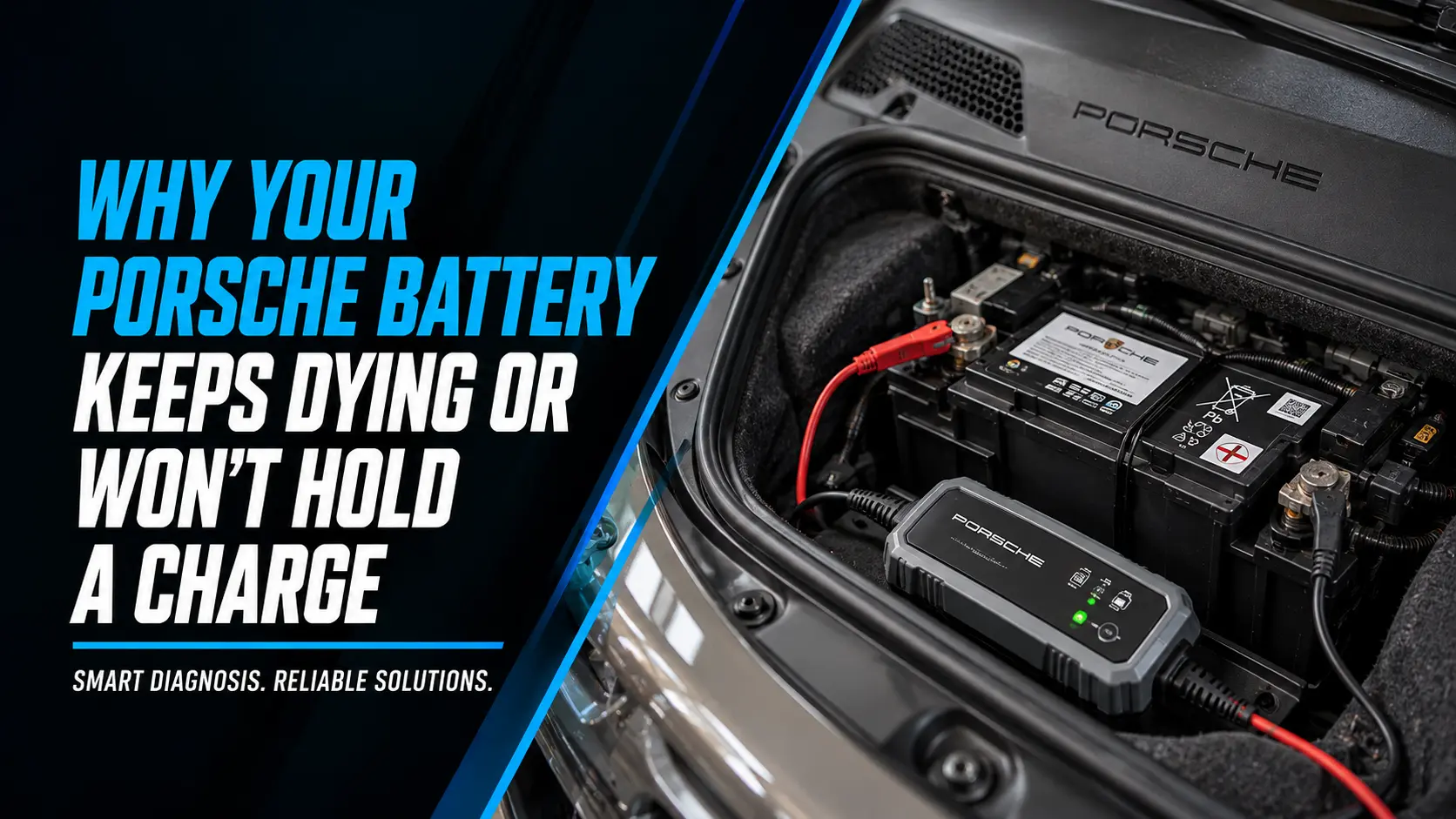
Monday morning. You get into the Porsche you drove once over the weekend, go to start it, and the dash flickers for half a second and goes dark. You’ve gotten used to keeping a jump pack handy.
As an independent Porsche specialist in the Fort Lauderdale area, we see this constantly with cars that only come out on weekends. Sitting for days at a time exposes a weak battery or an electrical drain that might go unnoticed with daily driving. When a Porsche keeps going dead, we start a Porsche diagnostic by checking three possibilities: the battery itself, excessive draw while parked, and the charging system.
- Three main causes. Most repeat dead-battery complaints come down to a weak battery, a parasitic draw, or a charging fault — and the fix depends on which.
- A new battery alone often isn’t enough. Porsches usually need a coded registration after a replacement; without it the car keeps charging on the old battery’s parameters, which can shorten the new one’s life.
- Measure before you replace. Battery testing appropriate for the battery type, a sleep-current measurement, and a charging check tell us which one you have.
- If the car mostly sits, the answer is often a maintainer. A maintainer matched to the battery’s chemistry, connected the way Porsche intends, usually breaks the cycle.
Why does my Porsche’s battery keep dying — weak battery, parasitic draw, or charging fault?
Most of the time it’s one of three things, and the symptoms can look surprisingly similar: how long the car sat, how it behaved after the jump, and the measurements and scan data together tell us which.
A new battery doesn’t cure a parasitic draw, and a new alternator doesn’t revive a tired battery, so before replacing anything we rule out the alternatives. Short, infrequent drives may not put back what starting and sitting take out, which is why so many of the cars that come to us for Porsche battery and electrical repair are cars that sit, not cars that are broken.
- Weak battery: Resting voltage looks normal, but the battery collapses under load. In South Florida that often shows up by the third or fourth summer.
- Parasitic draw: The battery is healthy, but a module or aftermarket accessory keeps pulling current after the car should be asleep. A car that dies after roughly the same number of days parked points toward a draw, though a weak battery can mimic it.
- Charging fault: The car isn’t recharging while it runs — alternator, regulator, a hybrid’s DC/DC converter, or a ground problem. One warning sign is a battery that dies again shortly after being jump-started and driven.
Dead after sitting all week usually means a weak battery or a draw; dying while driven regularly is more often a charging fault. If the battery and charging system test fine but the car still cranks intermittently or shows an immobilizer message, the ignition and key-authorization side needs testing — our Porsche ignition-lock guide covers that.
What drains a Porsche battery while it’s parked — and how much draw is normal?
A modern Porsche is never fully off. Once it has gone to sleep, normal draw is typically measured in tens of milliamps; sustained current well above that range calls for further testing to find what’s consuming power.
Several systems stay partly awake by design: the keyless-entry and alarm modules listening for the fob, the energy-management controller that wakes periodically to check the battery, the telematics and connected-car modules that call home on a schedule, and the clock and memory functions spread across the car. The car can take anywhere from about half an hour to a few hours to fully settle depending on what was done last — locking, unlocking, and opening a door to grab something resets the timer, and a fob within range can keep it partially awake.
Abnormal draw usually comes from a module that failed to sleep — most often a comfort or infotainment module, less often a stuck relay or a lid latch that intermittently reports open. Another common source is aftermarket equipment: a hard-wired dash cam whose parking mode isn’t configured correctly, a GPS tracker that never sleeps, or a piggyback module a prior owner installed can pull a few hundred milliamps around the clock, which is more than enough to leave a weekend car flat by Saturday.
Finding the source takes a settled car and a current clamp on the main battery cable, not a fuse-pulling session while the car is awake. On many models Porsche also has deeper transport and storage settings a shop can activate with PIWIS for a car that genuinely won’t move for months — useful for storage, but not a substitute for a maintainer on a car that’s driven every weekend.
Does a Porsche need a coded battery — and is it AGM or lithium?
On most current Porsches, yes. Whether it left the factory with an AGM (absorbent glass mat) or a lithium starter battery, the energy-management system has to be told a new one is in — skipping that can affect how the replacement is managed and shorten its service life.
Porsche specifies the battery chemistry for each car, and on models built with a lithium starter battery, substituting a conventional AGM isn’t an approved replacement even with coding — the replacement has to match the car’s requirements. South Florida heat shortens the life of any of them; our European car battery heat guide covers that side.
Where is the battery on a Porsche 911, Cayenne, Macan, or Panamera?
It depends on the platform, and that changes how a shop reaches it, how a maintainer connects, and what jump-starting the car even looks like.
- 911 (991.2 and 992): The battery lives in the front luggage compartment; a 992 is coded to either an AGM or a lithium battery, depending on how it left the factory.
- Cayenne (958.2 and 9YA): On the 958.2 the main battery sits beneath the driver’s seat, so access means releasing the seat fasteners and tilting it back. The 9YA (2019 on) moved it beneath the front passenger’s footwell floor, and many early 9YAs carry a 12-volt lithium battery rather than an AGM. Both generations have remote jump terminals in the engine bay.
- Macan (95B) and Panamera (971): On most builds the battery sits beneath the luggage-compartment floor, again with remote terminals up front for jump-starting. The hybrid Panamera and Cayenne add a high-voltage system with its own battery; a flat 12-volt battery can still strand those cars, and a 12-volt replacement doesn’t touch the high-voltage pack.
What does PIWIS battery registration actually do after a Porsche battery replacement?
It tells the energy-management controller that a new battery is installed, what chemistry and capacity it is, and resets the state the controller built up around the old one.
PIWIS, Porsche’s factory diagnostic system, handles this at the factory level, and a well-equipped independent shop with the right platform can perform the same registration. The procedure resets the controller’s aging and charge-acceptance model, updates the rated capacity, and lets the charging strategy start fresh. If the step is skipped, the symptoms that tend to follow are:
- Energy-saving behavior at the wrong time: Comfort features drop offline sooner than they should because the car believes the battery is weaker than it is.
- Stored energy-management faults: These may also need review — we distinguish old fault codes from active problems and confirm the energy-management system recognizes the replacement correctly.
On models that require it, registration is part of the replacement procedure, and we include it. If a shop replaces the battery and says nothing needs to be coded or reset, that’s worth a second opinion.
A Porsche that keeps losing its charge can pass a quick voltage check and still have a real battery problem. In the bay we compare battery health, charging behavior, and the current the car draws after it goes to sleep — and those results tell us where to look before anyone recommends parts.
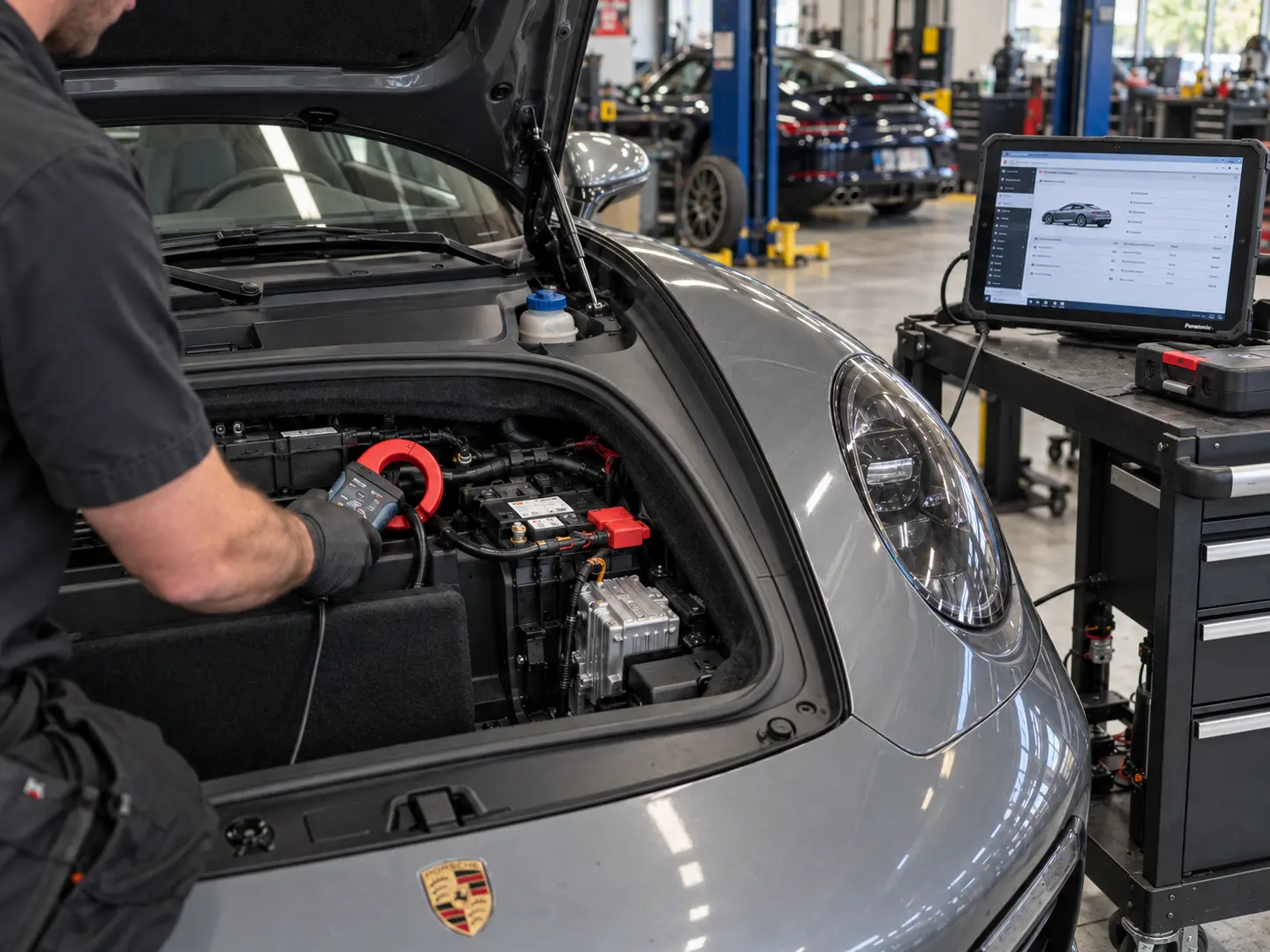
How do we diagnose a Porsche battery that won’t hold a charge?
We start with the battery’s condition, then check whether the charging system is working properly and whether anything is drawing too much power while the car is parked.
That is what the diagnostic visit is for on a car that won’t hold a charge: a registered replacement if the battery is tired, a module repair if something won’t sleep, alternator or regulator work if the charging voltage is low. For how smart charging, sleep mode, and parasitic draw fit together on a modern European car, our automotive electrical architecture guide explains the load-control side.
What does a Porsche battery and charging-system test actually include?
Three measurements, then the car’s own stored data as the cross-check — and no parts until they all agree.
Owners often arrive having had a voltmeter held to the battery and a code read in a parking lot. Neither finds a parasitic draw or a marginal alternator. The sequence we run instead:
What does a charging-system fault look like on a Porsche?
Charging faults can be easy to overlook and expensive to misdiagnose — the car runs and drives normally right up until the battery is empty again.
The signatures that point us toward the charging side include:
- Low charging voltage with the engine running: Below the expected range at idle and not recovering at higher RPM. Many current Porsches vary alternator output deliberately — charging harder on deceleration and easing off at steady cruise — so the reading has to be judged against that strategy rather than a single fixed number.
- Dim or flickering electronics under load: Headlights that pulse with engine speed, or an infotainment system that restarts when the car moves from idle to driving.
- Belt and mechanical condition: A slipping or glazed drive belt reduces alternator output without necessarily setting a fault code, so we check belt tension and pulley condition as part of any charging evaluation.
- Lost charge acceptance: An AGM that has been deeply discharged repeatedly can stop accepting a full charge even when the charging system is fine. The car’s BMS data, read alongside a load test, helps separate this from a true charging fault.
On the hybrid Panamera and Cayenne there is no conventional alternator; a DC/DC converter charges the 12-volt battery from the high-voltage pack, and a converter fault produces the same “the battery keeps dying” complaint. The measurement sequence has to account for that difference.
How do you keep a weekend Porsche’s battery from going dead?
For a Porsche that sits more than it drives, a maintainer matched to the battery’s chemistry and connected the way Porsche intends usually prevents the cycle. That means a proper automatic maintainer, not a basic unregulated charger.
- A charging program approved for the battery’s chemistry: AGM and lithium starter batteries need different profiles, and an unsuitable charger can shorten battery life or damage the battery.
- An automatic charger with a maintenance mode: A quality unit that charges the battery correctly and then switches itself to a safe maintenance program once it’s full.
- Connected where Porsche intends: Connection points vary by generation — on newer models, including the 992, Porsche specifies designated charging terminals for extended maintenance charging rather than the 12-volt socket. Your owner’s manual says which — and use a GFCI outlet, never an extension-cord daisy chain.
- Running whenever the car will sit more than about a week: For the once-a-weekend driver, we usually say plug in anyway.
Longer drives help too: they give the battery far more recovery time than short errands, though a deeply discharged battery may need hours on a compatible charger — driving alone won’t always restore a full charge. If the car has already sat for months, start with our snowbird car storage guide before the first drive. A maintainer on a draw or a tired battery only slows the problem down.
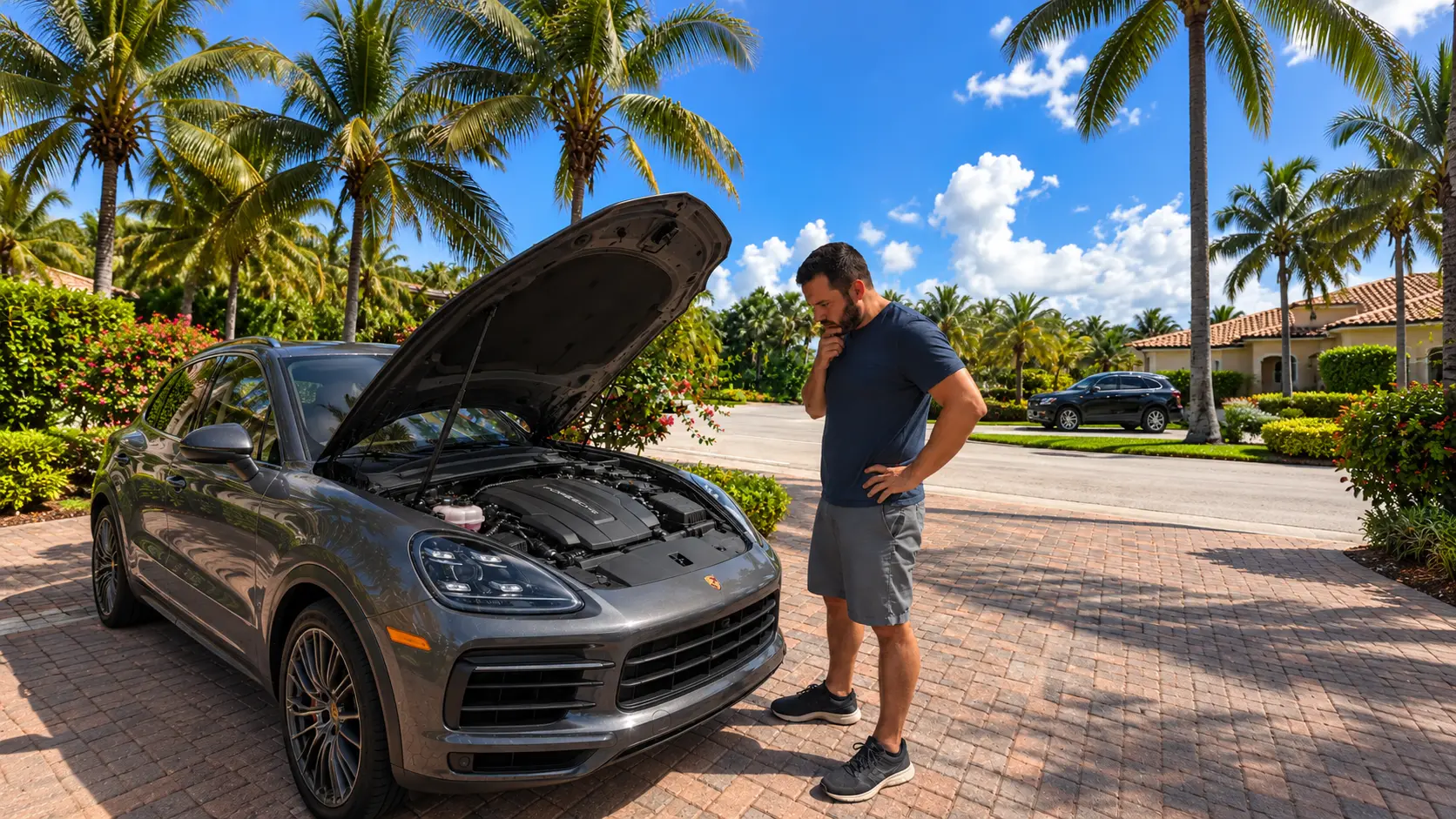
If your 911, Cayenne, Macan, or Panamera has gone dead more than once, we start by testing the battery and electrical system to find the cause. Motronix in Dania Beach serves Porsche owners from Fort Lauderdale, Hollywood, Miami, and the greater South Florida area, with the testing and PIWIS-level registration the job needs. Call or schedule below — we’ll find out why the battery keeps going dead and explain what needs fixing before recommending parts.
Related Porsche Reading
- European Car Battery Failure in Hot Climates — why South Florida shortens battery life, and the coding step most owners skip.
- Automotive Electrical Architecture and Load Control — smart charging, sleep mode, and why batteries “randomly” go dead.
- Automotive Diagnostic Methodology — why parts-swapping fails and how electrical testing is sequenced.
- 5 Porsche Warning Signs You Shouldn’t Ignore — the early signals, and what a Porsche diagnostic checks first.
- Why a Generic OBD2 Scanner Can’t Fix Your European Car — what a code reader misses, including battery registration.
- Common Porsche Repair Issues: Complete Guide — the ignition and electrical quirks that show up with age.
FAQ: Porsche battery that won’t hold a charge
How long does a Porsche battery usually last in South Florida?
I just replaced my Porsche battery and it’s dying again. What went wrong?
Can I put a bigger battery in my Porsche to stop it dying?
Is it safe to leave a maintainer on my Porsche for weeks?
My Porsche is a weekend car. Do I need a maintainer or just more driving?
Does Motronix do Porsche battery registration and BMS coding?
Technical References
- Midtronics — Battery Registration: What, Why and How To Do It? — why a replacement battery must be registered with the vehicle’s battery management system and what undercharging or overcharging follows when the step is skipped.
- OPTIMA Batteries (Clarios) — Can a Car Battery Go Dead From Sitting? — self-discharge, parasitic draw from modern vehicle electronics, and maintainer use for a vehicle that sits.
- Bosch Automotive Handbook (Robert Bosch GmbH) — AGM versus flooded battery construction, self-discharge, charge acceptance, and heat-driven degradation.
- Porsche AfterSales Technical Information 31/20 — Diagnosis and Handling of 12-Volt Lithium-Ion Battery, Rev. 9, April 7, 2026 (NHTSA document MC-11032273-0001) — no approved conventional tester for the lithium battery, status read from PIWIS measured values, AGM substitution not permitted, and the reversible protection cut-out on the 992, 9YA, and Taycan.
- Battery Council International (BCI) — technical standards and battery-care guidance covering cold-cranking amps, reserve capacity, and AGM battery specifications.