

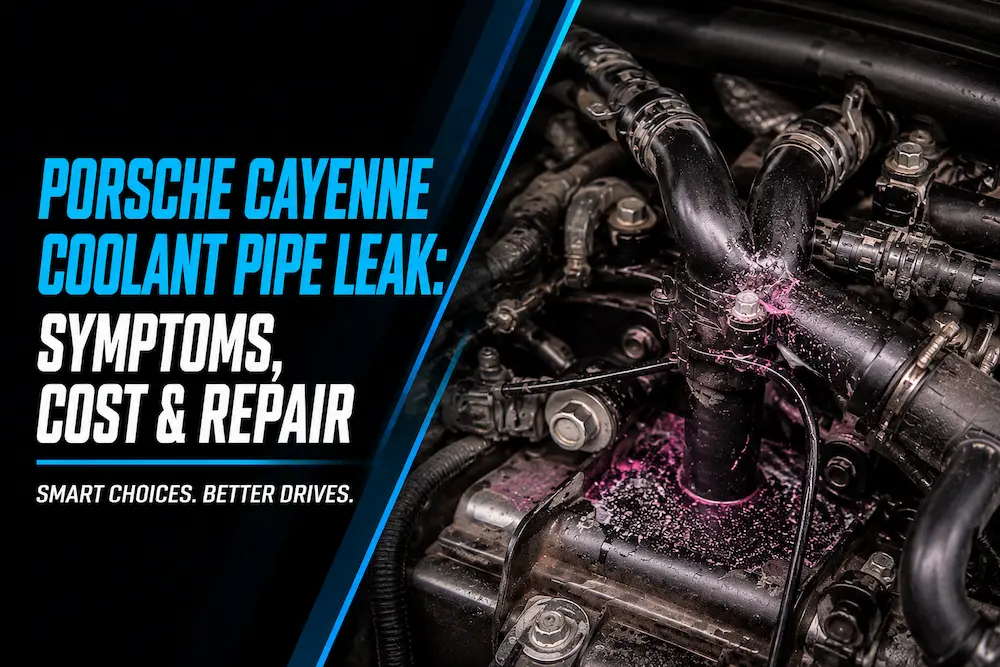
The first sign is usually a faint sweet smell after a longer drive — never enough to set off a warning light, never a puddle on the driveway, just something in the air around the engine bay when the car cools down. Then, weeks later, a low-coolant message that clears itself the next morning. The car drives fine. Nothing has overheated.
On Porsche’s V6 turbo Cayenne and Macan platforms, that quiet pattern is one of the most common signatures of coolant transfer pipe wear. The pipes themselves are inexpensive — often under $200 in parts. But they sit beneath the intake manifold in one of the worst access positions on the engine, which is what turns a cracked plastic seam into a 6-to-8-hour labor job. We see this frequently on Cayenne and Macan models here in South Florida, where the heat cycling is relentless. Our Porsche service hub explains how we work and what services we offer for these platforms.
- The transfer pipes route coolant between the V6 cylinder banks using mixed plastic and aluminum sections.
- Cracks develop at plastic-to-aluminum interfaces under repeated thermal cycling and sustained heat soak.
- Wear most commonly appears in the 70,000 to 110,000 mile window on V6 turbo platforms.
- Early symptoms are subtle — a faint sweet smell, a low-coolant message that clears itself, no visible puddle.
- The part is inexpensive, but access beneath the intake manifold makes labor the dominant cost factor.
- Replacing adjacent gaskets and seals during the repair prevents a repeat teardown at similar mileage.
Is this happening to your Porsche?
These are the patterns owners describe before transfer pipe seepage is confirmed.
- A faint sweet or syrupy smell around the engine bay after a longer drive, fading as the car cools
- An intermittent low-coolant warning that clears itself by the next start and never quite escalates
- A small wet film on the underside of the intake area, with no obvious puddle below
- The coolant level dropping a quarter-inch every few weeks without any visible drip on the driveway
- A faint hiss or pressure release sound from the engine bay shortly after shutdown
If most of those line up with what you have been noticing, the coolant transfer pipe area is one of the first places worth inspecting. Catching it at the seepage stage keeps the work focused on the pipes and adjacent gaskets, rather than letting the leak progress into a roadside overheat that brings other components into the conversation.
What is the coolant transfer pipe and what does it do on the V6 turbo?
It routes pressurized coolant between the cylinder banks through one of the most congested areas of the engine bay.
On a V-configured engine, coolant has to move between the two cylinder banks, the thermostat housing, the heater core feed, and the radiator return while keeping both banks at consistent temperature. The Cayenne and Macan V6 turbo achieves this with transfer pipes routed through the valley between the banks and along the sides of the block. Several sections are molded plastic (PA66 glass-filled nylon) with aluminum end fittings and pressed-in O-ring seals — a design that reduces weight and packaging volume in a tightly arranged engine bay.
Plastic is well-suited to the role under most conditions. It tolerates coolant chemistry, resists corrosion, and molds into the complex shapes needed to route around accessory drives and turbocharger plumbing. What it tolerates less well, over many years and thermal cycles, is the repeated stress at the joint between plastic and aluminum, where the two materials expand and contract at different rates. That joint is where most field failures originate.
Which Cayenne and Macan models are affected?
V6 turbo Cayenne (E3) and Macan (95B) from roughly 2016 through 2023 are the most commonly affected.
The Volkswagen Group V6 turbo platform shared between Porsche, Audi, and other group products uses similar coolant routing, and the transfer pipe wear pattern shows up across the family. The cooling system thermal management page covers how multi-circuit cooling architectures in European engines create these shared failure patterns.
- Porsche Cayenne (E3) — 2019 to 2023: Base V6 turbo and Cayenne S V6 twin-turbo are the most common platforms in our experience, with seepage typically appearing in the 70,000 to 110,000 mile range.
- Porsche Macan (95B) — 2017 to 2023: The 3.0L V6 turbo and the 2.9L twin-turbo Macan S and GTS share the same transfer pipe geometry. Macans tend to carry higher mileage through commuter use, which can move symptoms earlier.
- Late Cayenne (958.2) — 2015 to 2018: Earlier 958-generation V6 cars had related but not identical pipe layouts with their own documented wear patterns.
Twin-turbo variants tend to run at higher under-hood temperatures, which can shift the failure curve earlier — especially in cars used for short-trip driving where the coolant repeatedly heat-soaks but never reaches full operating stability.
What actually causes the transfer pipe to crack?
The cracks develop from thermal cycling stress at plastic-to-aluminum joints, accelerated by heat soak and chemistry exposure.
No single factor causes a transfer pipe to fail. The wear is cumulative, and several mechanisms work together over the life of the engine.
- Thermal expansion mismatch: Plastic and aluminum expand at meaningfully different rates with each heat cycle. Over tens of thousands of cycles, this differential stress concentrates at the joint, producing micro-cracks at the interface.
- Sustained heat soak after shutdown: When a turbocharged engine shuts down after sustained load, coolant in the pipes continues absorbing heat from surrounding metal. This post-shutdown soak holds the plastic at elevated temperatures longer than active operation, accelerating polymer aging.
- Coolant chemistry depletion: Coolant additives that protect plastics deplete over time. Degraded coolant becomes more aggressive toward both the plastic and the O-ring seals at joints. Vehicles past their recommended coolant service interval commonly show earlier seepage.
- O-ring seal aging: The pressed-in O-rings that seal plastic to aluminum harden and shrink over time. As the seal compresses less effectively, even small joint movement produces intermittent weeping under pressure.
- Vibration and packaging stress: The pipes route through a tight engine bay alongside intake and turbo plumbing. Vibration from adjacent components adds persistent mechanical load to the joints over years of service.
None of these produces an immediate failure. What they produce, in combination, is a gradual transition from a sealed system to one that begins to weep under pressure — usually first when fully heat-saturated, then later under any operating condition. Our coolant leak diagnosis and repair page covers how we identify these slow-progress leaks across European platforms.
What does early-stage failure feel like before overheating?
It usually feels like nothing — just small inconveniences that never add up to a clear fault.
Most owners notice the smell first. Coolant has a distinctive sweet odor when exposed to heat, and on a transfer pipe seep, the small amount that escapes vaporizes against hot engine surfaces before it pools. There is no drip, no warning light, no driveability change. What changes is the air around the engine bay after a longer drive, particularly in the few minutes after shutdown.
From there, the next signal is usually the coolant level itself. Most Cayenne and Macan owners do not check coolant weekly, so the level can drop slowly for months before a low-coolant warning interrupts a morning drive. The warning often clears within a day of topping off and never returns at the same urgency, which makes it easy to attribute to sensor behavior rather than ongoing fluid loss.
If the leak progresses, residue starts to appear — a powdery, crusty deposit at the leak point as evaporated coolant leaves behind its mineral content. By the time that residue is visible during an oil service, the leak has usually been active for some time. The Porsche 991 cooling system weak points guide covers a related set of cooling-circuit concerns on a different platform that often comes up during the same diagnostic conversation.

Why is the transfer pipe so labor-intensive to access?
The pipes sit beneath the intake manifold — almost everything on top of the engine comes off first.
On a more conventionally laid-out engine, a coolant pipe might be replaceable in an hour or two. On the V6 turbo Cayenne and Macan, the access path is the entire challenge. The intake manifold sits directly over the V valley where the transfer pipes route, which means the manifold, throttle housing, fuel rails, EVAP and PCV plumbing, and several wiring harnesses all come off before the technician can see the pipes.
Once the manifold is removed, the work is methodical rather than exotic. The pipes lift out, O-rings and gaskets are inspected, affected sections are replaced, and everything goes back in the order it came out. What makes the job substantial is the time required to disassemble and reassemble the upper engine cleanly — without introducing new leak paths through gaskets that should have been replaced while the area was open. This is why our approach to Porsche engine repair emphasizes evaluating adjacent components before the manifold goes back on.
What does the repair involve, and what should be replaced together?
The right scope goes beyond the cracked pipe to include surrounding gaskets, O-rings, and stressed adjacent components.
The labor cost of accessing the transfer pipe dominates the repair, which changes the math on what should be replaced while the engine is open. A repair that addresses only the visible crack often leaves several months of life on adjacent components that will require the same disassembly later. Most experienced Porsche shops approach this as a planned service interval, not a single-component fix.
- Cracked transfer pipe section and joint hardware: The primary repair. OEM replacement is generally preferred for fit and long-term durability; some aftermarket aluminum upgrade options are available for certain model years.
- All transfer pipe O-rings and gaskets: Even joints not currently leaking should be reset with fresh sealing components. Reusing aged O-rings risks introducing a new leak shortly after the repair.
- Intake manifold gaskets: The manifold has to come off regardless. Replacing its gaskets while open prevents a separate intake leak from becoming the next reason to open the engine.
- Thermostat housing inspection: The housing is plastic-bodied and ages on a similar curve. If it shows any sign of weeping or stress cracking, addressing it during the same job avoids a repeat disassembly.
- Coolant flush and full refill: Aged coolant that contributed to the original failure should not go back in. A complete drain, flush, and refill with Porsche-specification coolant resets the chemistry baseline.
The 911 shares the same failure mechanism with different access requirements. Independent testing on modular coolant connections confirms that electrochemical degradation and thermal cycling affect all cooling system junctions in the same thermal zone at comparable rates.
What you can check at home before booking a diagnostic
A few quick checks can confirm whether the transfer pipe is a likely suspect before you book.
None of these replace a proper pressure test, but they give both you and the technician useful context. Tracking a few of these signals over a couple of weeks before the appointment can save real diagnostic time.

- Porsche 991 cooling system weak points: what owners miss after the coolant pipe conversation
- Porsche 997 & 991 coolant expansion tank failures: a related plastic component wear pattern
- Porsche VarioCam timing problems: a parallel V6 wear pattern in the same mileage window
- Porsche check engine light: how cooling-related fault codes often surface alongside other systems
- Porsche AOS failure: another sealed-system component that degrades silently over time
FAQ: Porsche Cayenne & Macan Coolant Transfer Pipe Failure
How long does a Porsche Cayenne or Macan coolant transfer pipe typically last?
Is it safe to keep driving with a slow coolant pipe leak?
Why is the labor cost so much higher than the part cost?
Should I replace other cooling components at the same time?
Does this affect other Volkswagen Group V6 engines beyond Porsche?
Can I prevent transfer pipe wear with maintenance habits?
Technical References
- Pelican Parts — Porsche 958 Cayenne Coolant Hose Replacement Technical Article
- Gates TechZone — Understanding Modular Coolant Hose Failure
- Porsche Workshop Information System (PWIS) — Coolant Transfer Pipe Service Procedure, Cayenne/Macan V6 Turbo
- MAHLE Thermal Management — Engine Cooling Circuit Design and Material Selection for Turbocharged Applications
- Continental Automotive — EPDM and PA66-GF Compound Thermal Fatigue Testing Data for Automotive Coolant Systems