

You merge onto the highway, put your foot down, and the car just… doesn’t go. The tach climbs a little, then plateaus. The dash may show a wrench, an amber warning, or nothing at all. It happens once and you write it off. It happens again on a hot afternoon, and now you’re wondering whether you should be driving it home.
Across the late-model Porsche vehicles covered here — Cayenne (9Y0), Macan (95B), Panamera (971), and 991.2 / 992-generation 911 models — that “won’t pull past a point” moment is a common way a real fault first shows itself. The trap is that “losing power” and “stuck in limp mode” are not one problem. A Porsche that suddenly loses power on a hot merge and one that has gradually gone soft over months sit on two different diagnostic paths, and picking the wrong one is how a cracked charge pipe gets quoted as a turbo. Check out our Porsche repair page to learn more about how we work — and read on to find out which pattern fits your car.
- Two patterns, not one problem. A sudden power loss and a gradual one have different causes and different diagnostic paths.
- Sudden power loss often puts air, fuel pressure, and ignition high on the test list. A boost leak, wastegate or diverter fault, fuel-pump shortfall, or misfire that triggers an ECU-imposed limit.
- Gradual power loss often raises wear, deposits, and slowly deteriorating fuel delivery. Carbon buildup, oil-consumption side-effects, or a fuel pump slowly losing pressure margin.
- Limp mode is protection, not failure. The ECU limits engine output when it detects a fault or condition that makes full power inappropriate — on turbo engines that can mean sharply limiting boost.
- The pattern narrows the search. Onset, load-dependence, whether the dash lit up, and whether a restart clears it each help point at the responsible system.
- Live data settles it, not parts-guessing. Commanded vs. actual boost, wastegate feedback, and fuel-rail pressure across load.
What does “limp mode” actually mean on a Porsche?
It’s the engine control unit deliberately capping torque and boost when it sees something outside safe limits — a protective mode, not a failure by itself.
When a sensor reads out of range, an actuator doesn’t respond as commanded, a misfire or mechanical fault makes full power unsafe, or the ECU sees a mismatch it can’t resolve on the fly, it stops trusting that system and pulls back. On a turbocharged Porsche that shows up as boost sharply limited, softened throttle response, and revs that plateau well short of redline — the exact limit varies by model and fault. Naturally aspirated Porsches — such as a 718 GTS 4.0 or a GT3/GT3 RS — show it differently: a reduced-power flag and a soft top-end instead of a boost cut.
Limp mode is a symptom, not a diagnosis. The car didn’t break because it went into limp mode; it went into limp mode because something else broke. Confirming which module requested the torque reduction, and why, is the first step of a proper Porsche diagnostics visit — and on these engines, the “why” usually sorts into one of two patterns.
Sudden power loss vs. gradual power loss — which one do you have?
The onset pattern is one of the most useful things you can bring to a diagnosis, because it changes which systems get tested first.
It’s a triage shortcut, not an exhaustive diagnosis — mechanical, timing, and other less common faults can overlap either pattern. Still, it’s a strong first clue. A Porsche that felt normal on Tuesday and won’t rev out on Wednesday fits the sudden-onset pattern: often something in the air, fuel-pressure, or ignition system that broke or drifted past a threshold, so the ECU pulled boost and torque in response. A Porsche that has quietly lost its edge over six months — the on-ramp that used to pin you back doesn’t anymore, but no light, no message — fits the gradual-onset pattern, which shifts the first round of testing toward slowly developing conditions. Four useful patterns are:
- Sudden power loss with a check-engine light: Sudden-loss pattern. Usually load-dependent (fine at cruise, cuts power under acceleration). Air side (boost leak, wastegate, diverter, implausible boost-sensor readings), fuel pressure (HPFP, in-tank lift pump), or a misfire-triggered limit.
- Sudden power loss, no light, clears on restart: Sudden-loss pattern, leaning toward an intermittent sensor, electrical, or boost-control fault.
- Gradual soft top-end, no check-engine light, no single event: Gradual-loss pattern — slowly developing conditions like carbon deposits, oil consumption, or a fuel pump slowly losing pressure margin over time.
- Gradual loss with a stored code and rising fuel trims: Gradual-loss pattern; fuel delivery becomes one possibility, but trims alone don’t identify the pump — live rail-pressure data has to confirm it.
Which pattern you’re on shapes the parts likely at fault, the tests that matter, and the repair scope. The symptom-to-likely-cause patterns on our Porsche engine repair page are organized the same way, and everything below follows that split.
Why does a Porsche suddenly lose power or drop into limp mode?
On a turbocharged Porsche, a boost leak is one of the first faults to investigate — and the ECU catches it because it compares commanded boost to actual boost in real time.
A boost leak can create an underboost fault even when the turbocharger itself is capable of producing boost, which is why swapping the turbo doesn’t fix a leak. The other sudden-onset causes — a misbehaving wastegate or diverter valve, a boost or airflow sensor the ECU can’t reconcile, a misfire, or a fuel pump that can’t hold rail pressure under load — each leave a different fingerprint in live data. The sections below cover how a boost leak actually develops and the causes commonly mistaken for a tired turbo.
How is a wastegate or diverter-valve fault different from a boost leak on a Porsche?
All three starve the engine of boost; the driver’s impression usually can’t tell them apart, but they show up differently in live data.
A boost leak starts with the charge-air system itself: pressurized air travels from the compressor to the intake manifold through hoses, pipes, couplers, and seals that can deteriorate with age and repeated under-hood heat exposure — South Florida heat can accelerate the aging of some plastic and elastomer components. At light load a small leak is easy to miss, since the loss is tiny relative to total flow. Under high boost demand it becomes much more consequential: as pressure and airflow rise, the leak grows and the system may eventually be unable to hold the boost the ECU asked for. Many owners hear a faint hiss under acceleration before the reduced-power events become consistent.
A wastegate fault, a diverter fault, and a leak can all feel like weak or inconsistent boost, and the driver’s impression usually can’t distinguish them reliably — either over-boost, under-boost, or unstable boost gives the ECU a reason to cut power. Some electronically controlled actuators need a model-specific calibration or relearn after certain repairs or control-unit work; that should be verified against the procedure for the exact vehicle before any hardware is replaced.
The diverter (bypass) valve vents charge pressure back into the intake when the throttle closes, to prevent compressor surge. A leaking or malfunctioning bypass/diverter valve can mimic a charge-air leak or a weak turbo because it prevents the system from maintaining requested boost. Both the wastegate and the diverter are checked with the model-specific procedure — electronic actuator commands and position feedback where the system supports it, or vacuum and mechanical testing on vacuum-controlled hardware — not by ear.
Can a failing coil pack or spark plug put a Porsche into limp mode?
Yes — a misfire-triggered power cut is one of the fastest-acting limp-mode events, and a single weak coil or a plug past its interval can cause it.
Higher cylinder pressure under boost increases ignition-system demand, so a marginal plug or coil may misfire under load even when the engine runs smoothly at idle. A severe misfire can trigger rapid torque reduction and, depending on the DME strategy, fuel shutoff to an affected cylinder to protect the catalyst. What the stored codes look like tells you where to start:
- Cylinder-specific misfire codes (P030X): These identify the affected cylinder, which narrows the testing considerably — the cause can still be ignition, injector/fueling, wiring, compression, or a mechanical valvetrain problem. A sufficiently severe cylinder-specific misfire can trigger torque reduction or fuel shutoff for that cylinder.
- Random / multiple misfire (P0300): This doesn’t isolate one cylinder and can come from ignition, fueling, air-metering or intake faults, or mechanical problems. Freeze-frame and misfire data help narrow it.
- Heat-sensitive coils: A coil that tests fine cold can break down hot, so live misfire counters on a warm road test matter more than a bench check.
- Direct-injection plugs: Plugs can be electrically worn even when they don’t look damaged — service interval, gap, and live misfire counters matter more than appearance alone.
One caution: a misfire code does not automatically mean a coil. On turbocharged engines, a charge-air leak or a boost-control plausibility fault can produce load-dependent misfires that never appear at idle — which is why the ignition side and the boost side get checked together rather than in sequence.
What causes a Porsche to gradually lose power over time?
Gradual power loss usually shifts the diagnosis toward conditions that develop over time — deposits, ignition wear, fuel-delivery problems, and other slowly changing faults — and it can develop without a check-engine light, particularly early on.
Intake-valve carbon is one possible cause of reduced performance — it may develop gradually, though the symptom pattern alone doesn’t confirm it; the mechanism, cross-model pattern, and what a cleaning service involves are covered in our Porsche carbon-buildup guide. Rising oil consumption is another gradual-loss possibility that’s easy to overlook — fouled plugs and extra intake deposits chip away at power in the same slow way — so if the dipstick is where you first noticed a change, start with our Porsche oil-consumption guide.
Another gradual-loss possibility that’s easy to overlook is the fuel-delivery side. A worn high-pressure fuel pump (HPFP) is one cause, but low-side supply, control or software faults, and fuel conditions can also leave rail pressure below target — so top-end performance quietly softens under exactly the loads that stress it most, and it can be mistaken for ignition wear or a boost problem. The dropdown below covers how to tell.
How does a failing HPFP or in-tank fuel pump cause gradual Porsche power loss?
A weak pump doesn’t stop the car — it quietly fails to hold rail pressure at target under the highest demand, and that shortfall shows up as soft top-end power.
Modern Porsche direct-injection engines use a two-stage fuel system: an electric low-pressure lift pump in the tank feeds an engine-mounted high-pressure pump (HPFP) that raises rail pressure to whatever the ECU commands under load. Either pump can be marginal without the engine refusing to start, because most driving demands far less pressure than a worn pump can still deliver. The shortfall shows up under heavy load, especially when hot.
From the driver’s seat, an on-ramp that used to feel sharp goes soft at the top of the pull. A low-rail-pressure code (P0087, or a Porsche-specific pressure-deviation fault) may set and then clear before the car reaches a shop — but P0087 tells you rail pressure fell below target, not which part caused it. Depending on the failure mode there may also be starting or drivability symptoms, but those don’t identify which side of the fuel system is responsible — which is why coils, plugs, and injectors get replaced first on a lot of these cars before anyone monitors live fuel-rail pressure.
The two pumps fail differently. A weak low-pressure supply may fail to maintain pressure or volume under demand, while a marginal HPFP may fail to keep actual rail pressure near the commanded value; software, control faults, and fuel conditions can also leave pressure low. Comparing low-side and rail pressure under the conditions that reproduce the complaint — cold start, warm idle, full load, and hot restart — helps separate them before a single part comes off the car. The same shortfall can also appear suddenly: when rail pressure finally drops below a threshold under load, the ECU cuts power and stores the code.
How does a shop actually diagnose Porsche power loss without parts-guessing?
By reproducing the fault with live data running and comparing commanded to actual on every parameter that could be responsible — not by removing the parts most likely to be blamed.
Codes are pointers, not diagnoses. The job is to watch which parameter falls out of specification under the exact conditions that trigger the reduced-power event — measurement under the conditions that reproduce the complaint is far more reliable than replacing the component most commonly blamed.
The sections below show what that looks like, step by step and on the boost side specifically, plus what you can check before you book.
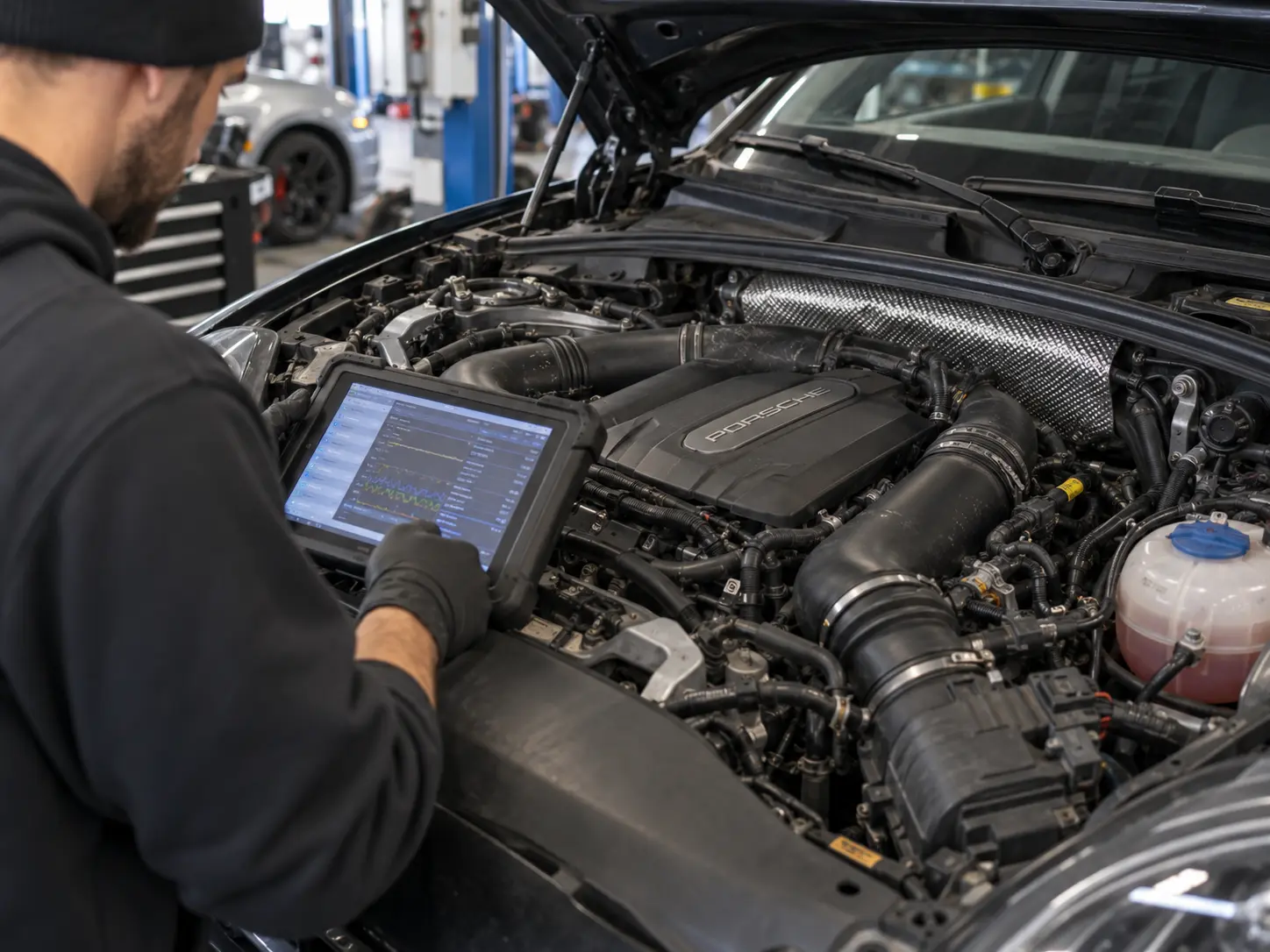
What exact tests and data does a Porsche power-loss diagnostic check, in order?
What’s the boost-control test sequence a shop runs on a sudden Porsche power loss?
A short, ordered sequence that isolates air-side faults before any parts come off the car.
- Pressure- or smoke-test the cold intake tract. Engine off, regulated compressed air or smoke into the intake through a test fitting. A cracked charge pipe or loose coupler often shows up here. If the system holds pressure and no leak is found, a charge-air leak becomes less likely and the diagnosis moves toward boost control, sensing, or the turbo itself.
- Read live boost vs. commanded on a road test. Look closely at requested versus actual boost in the moments before the reduced-power event: a growing deviation can point toward a leak or a boost-control problem. Once the DME has commanded reduced torque, the boost drop that follows is part of the protection response — not evidence by itself of which component failed — so the reading is confirmed with the targeted tests here.
- Test wastegate operation with the model-specific procedure. On electronic-wastegate systems the scan tool sweeps the actuator across its range and reads feedback; on vacuum-controlled systems it’s a vacuum and mechanical check. Anything that hesitates, sticks, or reads outside its expected range shows here.
- Command or inspect the diverter/bypass valve. Actuator testing confirms it moves; confirming it seals under actual boost may also take a pressure or smoke test. A valve that won’t fully seal can’t hold requested boost under load.
- Check the boost-pressure and airflow sensors for implausible readings. A dropping-out boost sensor or a contaminated MAF can report legitimate boost as a fault, and the ECU derates a mechanically healthy engine. Compare each sensor’s reading against expected physical values across the range.
Once the cause is identified, the repair scope is clear — and the parts that weren’t the fault don’t get replaced on the theory that “as long as we’re in there.” That’s how a boost leak stays a charge pipe instead of becoming a turbo quote.
What can I check on my Porsche at home before booking a power-loss diagnosis?
A few owner-level observations won’t replace a factory-level scan, but they give the technician a head start and help you gauge urgency.
- Write down the conditions: Only at high rpm, only at wide-open throttle, or at any load? Consistent or intermittent? Cold start or only once warm? “It does it above 4,500 rpm on the on-ramp” is far more useful than “it feels sluggish.”
- Look at the charge pipes: With the engine off and cool, follow the intercooler piping for cracks in the rubber or silicone sections and couplers that have slipped off their fittings. A leak sometimes leaves a faint oily or dusty line along the crack. Not always visible, but worth five minutes.
- Read the codes if you have a basic reader: Even a generic OBD-II tool gives you the P-code. P030X narrows the conversation to a cylinder; P0299 points at underboost; P0087 points at fuel pressure. Don’t clear them — the freeze-frame is the most useful thing the car recorded.
- Note the light’s behavior: Steady or flashing? A flashing check-engine light generally indicates a severe misfire that can damage the catalytic converter — reduce speed and seek service promptly.
Is it safe to keep driving a Porsche in limp mode?
Sometimes — it depends on the warning message and what else the car is doing. Follow the message in the instrument cluster, and when in doubt, stop and call.
Reduced-power mode is protective, but it does not automatically mean the car is safe to keep driving. If the cluster explicitly says driving is permitted, there are no red oil-pressure, coolant-temperature, or other critical warnings, the engine is running smoothly, and there are no abnormal mechanical noises, you can generally drive gently only as far as needed to reach a safe location or a shop. If the check-engine light is flashing, the engine is misfiring or shaking, temperature or oil-pressure warnings appear, fluids are being lost, or you hear abnormal mechanical noise, stop and tow the car. Getting home from the on-ramp is not the same as ignoring it for two weeks — two questions decide the urgency.
First, does it repeat? A single reduced-power event followed by a week of normal driving may be a marginal sensor, a lost calibration, or a fault that is intermittent or hasn’t met the criteria on every drive. If it fully clears and there are no critical warnings, misfires, fluid loss, or abnormal noises, towing may not be necessary — but the event still deserves diagnosis soon. Repeat events under the same conditions — same speed, same load, same heat — mean the fault is reliable and worth diagnosing before it strands you.
Second, is anything stacking with it? A rough idle, a metallic note from the turbo housing, coolant or oil going missing, or a check-engine light that is now flashing rather than steady turn “book it this week” into “don’t drive it, tow it.” A steady light with reduced power and nothing else is the ordinary case — what the difference between a steady and a flashing light means for urgency is covered in our Porsche check engine light guide. Whichever case you’re in, come in with the pattern — onset, load, whether a restart cleared it, steady or flashing — and you give the technician a much better chance of reproducing and measuring an intermittent fault. That is where the diagnosis starts.

If your Porsche has started cutting power on merges, has quietly gone soft over the last few months, or has been quoted a turbo before anyone put a scan tool on it, the fastest path to a confirmed diagnosis is sorting the pattern before naming a part — which is how we work. Motronix in Dania Beach serves Porsche owners from Fort Lauderdale, Hollywood, Miami, and the greater South Florida area with factory-level, live-data power-loss and limp-mode diagnosis on the Cayenne, Macan, Panamera, and 911. Book a diagnostic and we’ll get you a confirmed answer instead of a parts list.
Related Porsche Reading
- Porsche Carbon Buildup Symptoms: 911, Cayenne & Macan — the intake-valve deposit problem behind rough cold starts and gradual power loss, and what walnut blasting fixes.
- Porsche Oil Consumption: Why It Happens & What’s Normal — when consumption between changes is within range and when it’s a diagnostic signal.
- Porsche VarioCam Timing Problems — a timing-side fault with its own cold-start rattle and rough-running signature.
- Why a Generic OBD2 Scanner Can’t Fix Your European Car — why a code read is not a diagnosis, and what factory-level access adds.
- Automotive Diagnostic Methodology — the reasoning behind measure-first diagnosis and why parts-swapping fails even when it “works” once.
FAQ: Porsche Losing Power or Stuck in Limp Mode
Can I drive my Porsche home if it just dropped into limp mode?
Does a Porsche losing power always mean the turbo is failing?
Why did my Porsche lose power once and then run fine for a week?
What are common causes of limp mode on a Cayenne or Macan?
Why does my Porsche only lose power under hard acceleration?
Should I just clear the codes and see if it comes back?
Technical References
- Bosch Mobility — Gasoline Direct Injection — how the high-pressure pump, fuel rail, and injection system deliver the commanded rail pressure on a direct-injection engine — the fuel-delivery side of a power-loss diagnosis.
- AutoSuccess / Babcox Media — Diagnosing Turbo Boost and Leak Problems — wastegate, diverter-valve, and under-boost leak diagnosis applicable to turbocharged Porsche charge-air systems.
- Bosch Automotive Handbook (Robert Bosch GmbH) — turbocharger boost control, wastegate regulation, and direct-injection fuel-delivery architecture.
- Porsche factory technical information (PIWIS / dealer service documentation) — boost-control, fuel-system, and actuator-test procedures for the 9Y0, 95B, 971, and 991.2 / 992 platforms.
- Turbocharger and actuator supplier engineering documentation (e.g., BorgWarner, MAHLE) — wastegate and diverter-valve operation, adaptation, and failure modes on OEM turbo systems.