
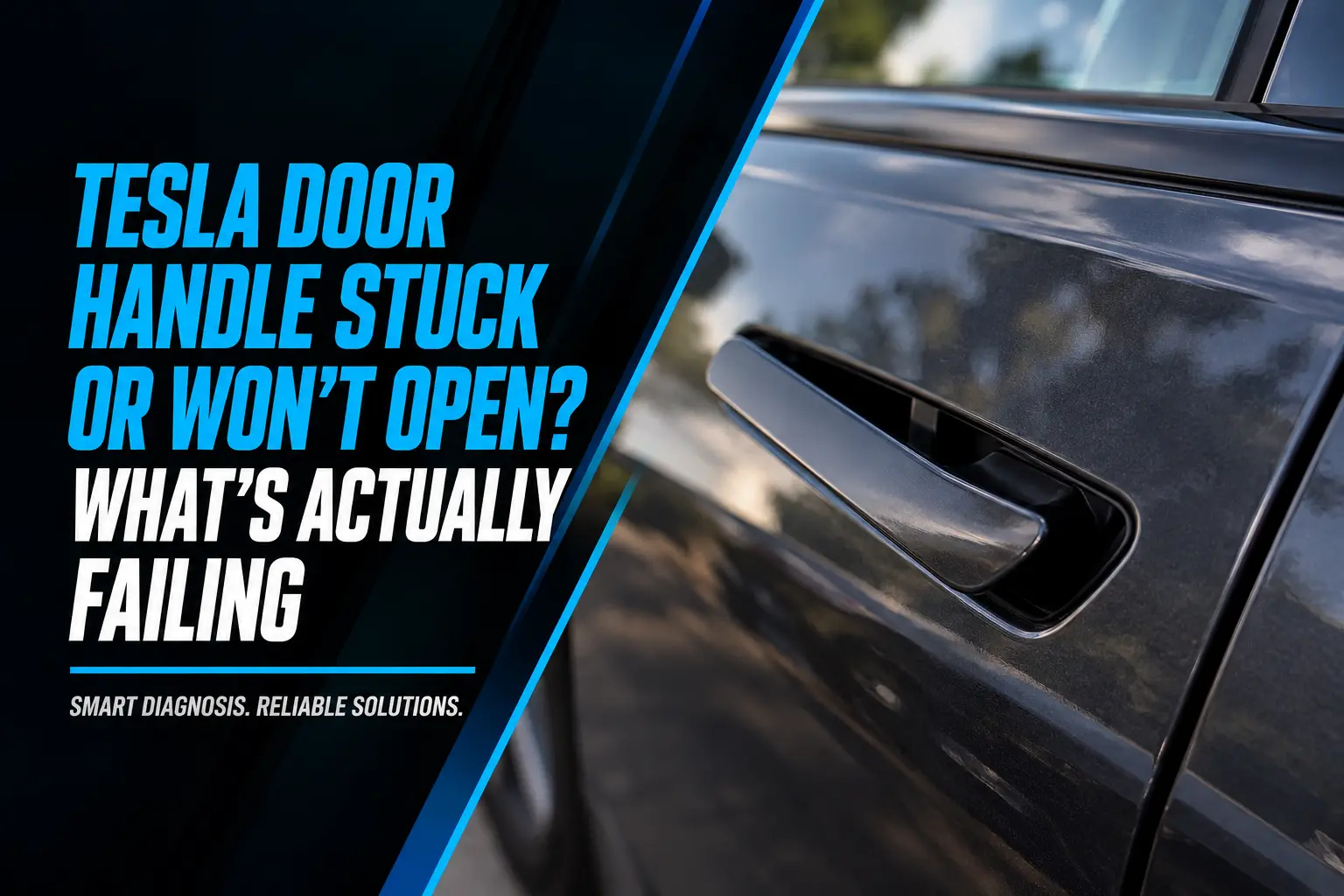
You press the flush handle on your Tesla and nothing happens: no click, no window drop, no door. Or the handle pivots out and the door still won’t release. Either way, the car may be unlocked and working normally, and that door still won’t open.
We see door-handle complaints regularly in our Tesla service work, and once the car is unlocked and recognizes the key, the cause is usually a worn part in that one door’s handle or latch — or a low-voltage battery too weak to run the locks. Most of the detail below covers the 2017–2023 Model 3 and 2020–2023 Model Y flush handle; Model S and Model X use different handle designs.
- Two main causes. Once the car is unlocked and sees the key, it’s usually a worn handle or latch part on one door, or a low-voltage battery too weak to run the locks.
- Small parts wear first. On Model 3 and Model Y, a small sensor in the handle and the electric latch do the work.
- Every Tesla has an interior front manual release. It lets occupants get out when the electronic release has no power — it won’t unlock the car from outside. Rear releases vary by model and year.
- Diagnose before replacing. Low-voltage testing, Tesla-specific diagnostic data, and targeted door-circuit checks identify the actual fault before any parts are ordered.
Why won’t my Tesla door open — and which part is usually failing?
If only one door is affected, we start with its handle, latch, and wiring; if all four are dead, suspect the low-voltage battery.
A Tesla’s exterior handle has no mechanical link to the latch — the handle trips a sensor and the car releases the latch electrically — so when an owner calls, the first things we ask are which doors are affected, what the screen is doing, and whether the window drops. The answers usually tell us where to start:
- One door, car otherwise normal: Screen wakes, app connects, three doors work. This usually points to that door’s handle sensor, latch, or wiring.
- Handle pivots and the window drops, but the door won’t release: The handle signal is probably getting through, so we focus on the latch, its wiring, and the release command. If the handle pivots but the window doesn’t move, we confirm whether the signal was received before blaming the sensor.
- Fine in the morning, dead after a hot afternoon: A handle that fails after sitting in the sun may have a temperature-sensitive sensor, connector, or wiring fault; we reproduce the symptom under the conditions it occurs in.
- All four doors dead, car dark: No welcome lights, no screen, no app connection. That is more often the 12V battery than four handles failing at once.
Before we quote a handle, we confirm the 12V side as part of our Tesla battery and electrical repair work, because a new handle does nothing for a car that can’t power it.
How does a Model 3 or Model Y flush door handle work, and what fails inside it?
The handle pivots mechanically, but the latch opens electrically — and problems can occur on either side.
Pressing the wide end of the flush panel pivots the narrow end out toward your hand, and a Hall-effect sensor in the handle registers that movement. If the car is unlocked (phone key nearby or key card tapped), the body controller commands the electric latch to release, which is why the door opens whether you pull the handle or just the door’s edge. At the same moment the frameless glass drops a few millimeters so it clears the body seal; you may hear the latch release and the glass lower slightly before the door opens. The main components we inspect, starting with what can be checked at the connector and the scan tool before anything is unbolted:
- Handle sensor and wiring: The Hall-effect sensor registers handle movement and signals the door-opening system; a damaged sensor, a wiring fault, or a poor connection can cause intermittent or complete failure, so we inspect the connector for corrosion before replacing parts.
- Latch assembly: The electric latch does the actual releasing. When it fails, the handle feels normal and the door stays shut.
- Handle pivot and return spring: A handle that feels loose, sticks out, won’t sit flush, or is physically stiff usually has a worn, contaminated, or binding pivot or spring rather than an electrical fault — some sticking can be addressed from outside without removing the door panel.
- Connector corrosion: Water that gets inside the door can reach the handle and latch connectors, and corroded pins can mimic a tired sensor.
Sensor, wiring, and latch repairs mean the interior door panel comes off, though some mechanical sticking can be dealt with from outside. Because every step after the pivot is a low-voltage command, a power-supply problem can interrupt that process too, and reading the body-control module helps show which step did not happen before anyone orders a part.
Why might the driver’s door handle on a Tesla Model 3 or Model Y wear out sooner?
It’s a usage-cycle issue more than a design one: the driver’s door opens on every trip, the other three open occasionally.
Over a few years the driver’s handle can see several times the cycles of the other three doors. The driver’s handle simply gets used more, giving its sensor wiring and pivot more chances to wear — which is why we ask how each door gets used. On a Model 3 or Model Y used for ride-share work, the rear passenger-side door sees far more cycles than usual, so it can wear out sooner. If two or more doors start acting up around the same time, we check for a shared electrical problem before assuming several handles failed independently.
What about the door handles on a Model S or Model X?
A Model S uses motorized presenting handles and a Model X uses press-to-open handles, so the parts that fail differ, though the diagnosis starts the same way.
On a Model S, each presenting handle sits on a motorized arm. When the handle is pressed or the car senses the key, the motor runs the extend cycle; pulling the handle then signals the latch to release. The parts that tend to fail are the handle motor, the sensors and wiring inside the handle (the harness flexes every cycle and can crack or corrode), and the pivot bushings. Salt air and sun exposure in South Florida can be hard on the seals and bushings.
A stuck presenting handle is usually not a reason to stop driving, but we’d recommend against forcing it out by hand. The motor and plastic drive gears aren’t meant to be pushed against, and a handle can stay retracted for a protective reason, such as a failed position sensor. What we check first on a Model S is whether the other handles still present normally: one stuck handle points at that handle’s motor or sensor, while several stuck at once point at low-voltage power or the body module before any handle.
Is it the handle, or is your Tesla’s low-voltage battery dead?
If the whole car is asleep — dark screen, no welcome lights, an app that can’t connect — the low-voltage battery is the first suspect, and a handle repair would be the wrong fix.
Tesla’s low-voltage battery (a 12V lead-acid unit on earlier cars; many later Model 3/Y builds use a higher-voltage lithium-ion unit) runs the locks, latches, screen, and wake logic, so a battery below the wake threshold leaves every door dead at once; a marginal one can leave some handles working and others not. Our Tesla 12-volt battery warning cascades guide and Tesla no-power triage guide cover the electrical side. In the bay, we settle it with a short Tesla diagnostic sequence:
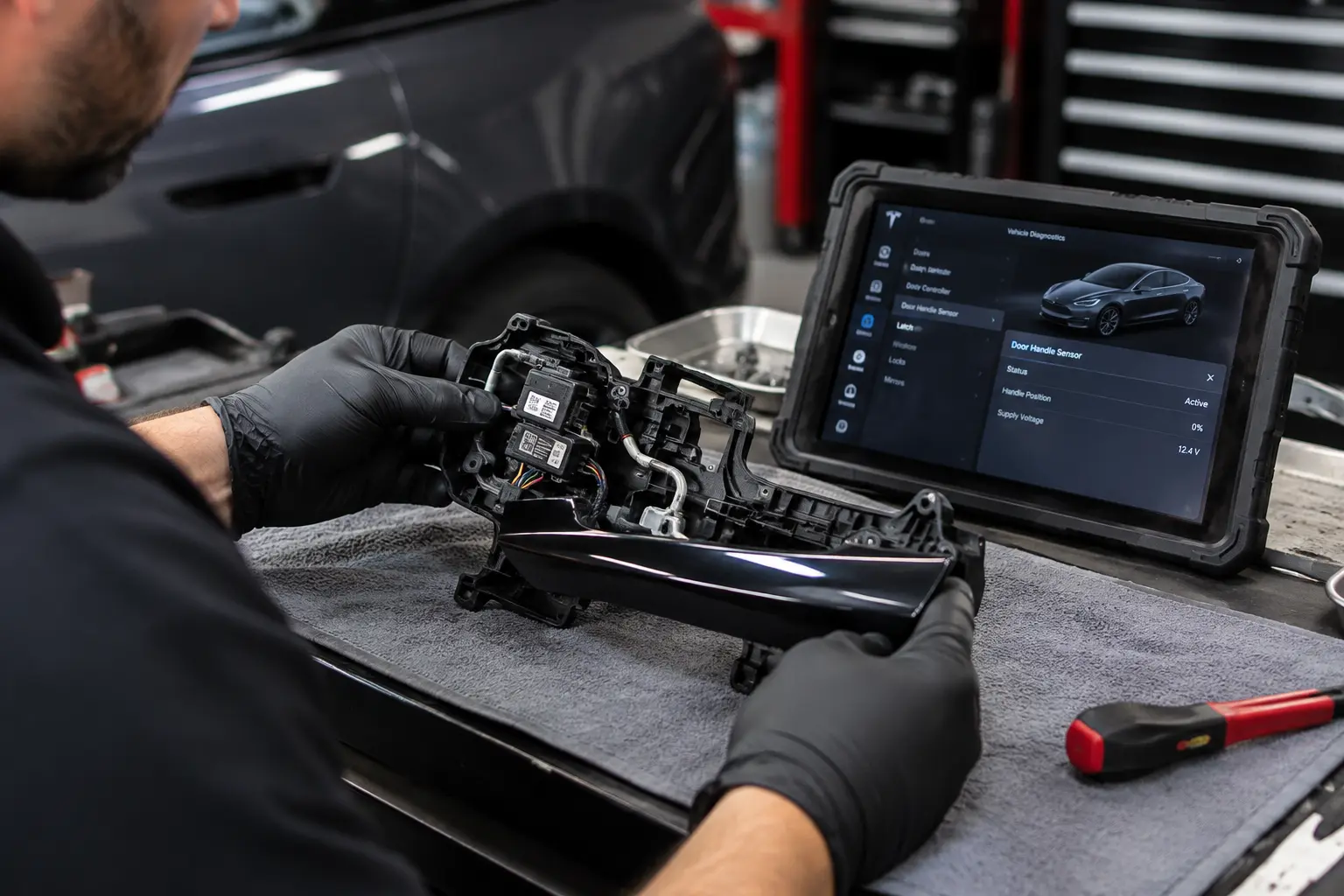
- Low-voltage power check under load: We watch whether the battery holds voltage while the car wakes its body modules; resting voltage alone says little on a Tesla.
- Body-control module scan: Available fault records, handle inputs, and latch commands can provide useful diagnostic information; intermittent faults sometimes have to be reproduced and tested directly.
- Retest on verified low-voltage power: We confirm stable power using the procedure for that car’s battery type (lead-acid or lithium), then retry the door. If it works, we look at the battery and supply circuit before touching door parts; if it stays dead, we test the handle sensor, wiring, latch, and control signals individually.
What can I check at home before booking a Tesla door-handle appointment?
Sensor and latch repairs need access inside the door, but you can usually tell us whether it’s a power problem, a handle that’s binding, or a handle that isn’t signaling — which saves time at the shop.
What not to do: pry on a flush handle, force it with a tool, or keep running a weak 12V flat in the driveway. None of those help the diagnosis, and some add a second problem to the one you’re already paying to fix.
What does a Tesla door-handle repair involve, and what should it include?
Once we’ve confirmed which part failed, many Model 3 and Model Y handle or latch repairs can be done in a day if the correct part is available. We remove the door panel, replace the failed component, and test the door before putting everything back together.
On a Model 3 or Model Y the door panel’s plastic clips need the right trim tool, the inner access panel behind the trim comes off, and the handle or latch is unbolted and swapped. The exterior handle is the deeper job: the door glass has to come out to reach it, and the window is recalibrated afterward. The car is tested before the access panel and trim go back on. What a well-done repair should include:
With the panel off, we test the handle sensor and the latch separately rather than replacing parts on the symptom alone. An intermittent sensor gets checked warm and again after it cools, because the heat-sensitive ones often pass a quick test in an air-conditioned bay, and the latch is commanded directly from the scan tool so we know whether it moves at all.
- Correct part for the build: Handle and latch part numbers can differ by build date, so the replacement should be matched to the car’s VIN.
- Connector and harness inspection: We check these before closing the door up, because if corrosion was part of the chain, replacing only the handle leaves the water-ingress source behind.
- Function test on both handles: Several cycles from outside and inside, with the latch hold, release, and glass drop confirmed.
- Final verification: We confirm the repair, check for returning faults, and retest the door after the car has completed a normal sleep-and-wake cycle.
The door panel is the delicate part of the job and the usual place a repair leaves a lasting flaw: a cracked clip, a misaligned seam, or an access panel that isn’t fully seated. Poorly seated trim leaves rattles, loose seams, or broken clips.
Where are the manual door releases on a Tesla?
Every Tesla has an interior mechanical release on the front doors that lets occupants out with no power; rear releases vary by model and year, and none of them unlock the car from outside.
- Model 3 and Model Y front doors: A small lever at the top of the armrest, just ahead of the window switches. Pull up and the latch opens.
- Model 3 and Model Y rear doors: On the 2017–2023 Model 3 the owner’s manual identifies releases for the front doors only; a concealed rear release cable exists behind an armrest access panel but takes tools to reach, so rear passengers get out through a front door. Some Model Y cars have a cable at the bottom of the rear door pocket: lift out the mat, remove the access cover, and pull the cable forward.
- Model S and Model X front doors: On newer cars, a manual release just ahead of the window switches; pull it up. On 2012–2020 Model S, the interior door handle itself works without power.
- Model S rear doors: A release cable under the edge of the carpet below the rear seat; pull it toward the center of the car. Model X falcon-wing doors: A cable behind the door’s speaker grille.
A manual release skips the glass drop, so treat it as a workaround, not a daily entry method.
Will using the Tesla manual door release damage the window?
It can, which is why Tesla reserves it for when the car has no power.
Tesla’s door design drops the frameless glass a few millimeters before the door opens so the glass clears the body seal. The manual release skips that drop, so the glass edge drags on the seal on the way out. Tesla’s manual warns that this can damage the window or trim, so open the door slowly and use the release only when you have to; using it every time because the handle is intermittent tends to show up as a worn weatherstrip or a mark along the glass edge. If the manual release is becoming part of daily driving, the handle needs repair, not a long-term workaround.
How urgent is a stuck Tesla door handle, and when should you call a shop?
If only the exterior handle has failed and the door still opens normally from inside, the car is usually usable for a while — but a door that won’t open reliably from inside needs prompt attention.
A passenger or rear door with a working interior release can often wait a short time. If anyone could have trouble getting out, book it now.
Call when any handle turns intermittent or more than one door fails: handle and latch wear don’t recover on their own, and a deteriorating low-voltage battery can eventually keep the car from waking at all.
If your Tesla door won’t open, one door or all four, we find out why before we quote a repair. Motronix in Dania Beach serves Tesla owners from Fort Lauderdale, Hollywood, Miami, and the greater South Florida area. Call or schedule below.
Related Tesla Reading
- Why Tesla 12-Volt Battery Failures Trigger Multiple Warnings — what else goes offline when the 12V is marginal.
- Tesla Won’t Wake Up or Turn On? No-Power Triage — for a car that is completely asleep, not one dead door.
- Tesla Phantom Drain: Why It Happens and How to Fix It — when a weak 12V is hiding behind what looks like overnight range loss.
- Tesla Touchscreen Frozen, Black, or Unresponsive? — when the dark screen itself is the suspect.
- Automotive Electrical System Architecture — the principles behind sleep mode, parasitic draw, and heat-related faults.
- Automotive Diagnostic Methodology — why parts-swapping fails and how intermittent faults are approached.
FAQ: Tesla door won’t open
Can I open a Tesla from outside if the handle is broken?
Will a failed Tesla door handle show a warning on the touchscreen?
What affects the cost of a Tesla door-handle repair?
Will Tesla fix a door handle under warranty?
Do all four doors on a Model 3 or Model Y use the same handle assembly?
Technical References
- Tesla, Inc. — Model 3 Owner’s Manual (2017–2023) — manufacturer documentation of door operation, the interior door button, and the front-door manual release (“Opening Doors with No Power”).
- Electronic Code of Federal Regulations — 49 CFR § 571.206, Standard No. 206: Door Locks and Door Retention Components — the federal safety standard governing passenger-car door latch and lock performance.
- SAE International — SAE J839, Passenger Car Side Door Latch Systems (SAE International standard).
- Tesla, Inc. — Tesla Service Manual, 2017–2023 Model 3 and Model Y (service.tesla.com) — the exterior door handle remove-and-replace procedure (Hall-effect sensor, door-glass removal, window calibration) and the “Manual Release – Door – Rear (Actuate)” procedure documenting the concealed rear release cable.
- Robert Bosch GmbH — Bosch Automotive Handbook (body electronics and low-voltage vehicle electrical system chapters).