
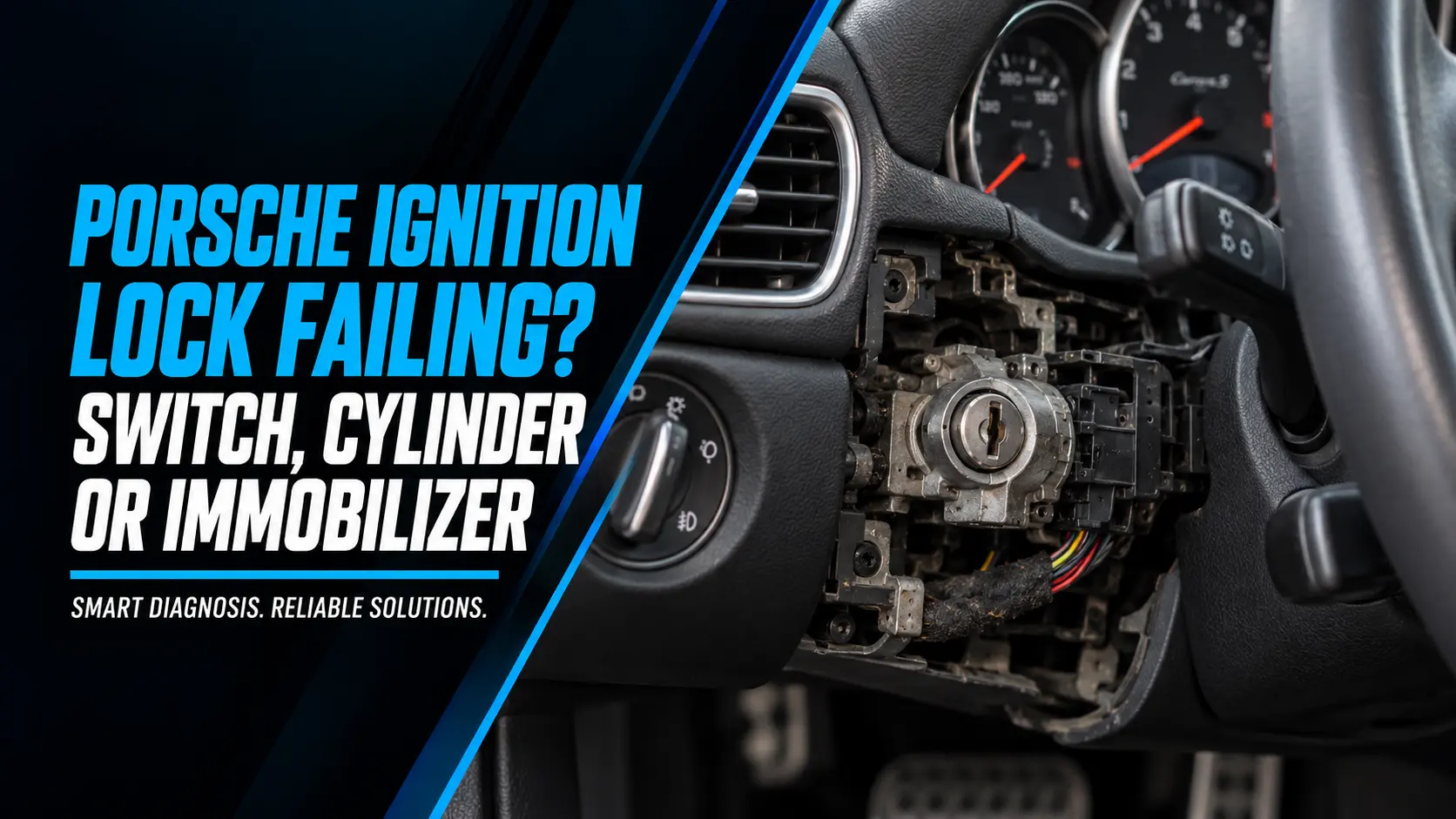
“Ignition lock” is what owners call it when a Porsche won’t start, the key won’t turn, or the dash goes dark. Across Porsche generations it can involve four different things — the lock cylinder, the electrical ignition switch, the steering lock, and the immobilizer that decides whether the key is genuine — and which ones your car actually has depends on the generation.
As an independent Porsche specialist in the Fort Lauderdale area, we usually meet this complaint with a part already picked out. Here is which symptoms point where, what’s urgent, and why we confirm the failed part before anything gets ordered.
- “Ignition lock” can mean four different systems. Lock cylinder, electrical switch, steering lock and immobilizer — the exact setup depends on the Porsche generation.
- On a 986 Boxster or 996 911, suspect the electrical switch. A small, separately replaceable part behind the lock — the classic failure.
- Lights on, no crank doesn’t prove the switch. A weak battery, a starter-circuit fault, the DME relay or the immobilizer can overlap with switch symptoms enough to be confused from the driver’s seat.
- A key that won’t turn is often not a failure. Steering-lock preload releases when you rock the wheel; a worn cylinder doesn’t.
- Cutting out while driving is the urgent version. A switch that drops the ignition at speed takes the engine and the assist with it.
- Newer Porsches move the problem into electronics. Low voltage, the key or fob, the electronic steering lock and software can all produce an “ignition lock” no-start.
What are the symptoms of a failing ignition switch or lock on a Porsche?
Intermittent no-starts, a dash that flickers as the key turns, a key that fights you, and — in the worst case — an engine that cuts out on the move.
The tell is inconsistency: the car starts nine times, does nothing on the tenth, then starts after the key is wiggled. Worth writing down before you call:
- Nothing happens when you turn the key: No starter click, often with the dash dropping out at the same moment — then it works on the next try.
- Accessories flicker as the key moves: Radio, gauges or lights cutting in and out while you turn the key is the clearest sign of worn contacts inside the switch.
- The engine dies while driving: A momentary loss of ignition at speed that clears when the key is nudged. This one is a safety problem first.
- The key is stiff, gritty, or hard to insert or turn: Points more toward the key blade, the lock barrel or the mechanical lock mechanism. On a 986/996, a key that fails to spring back from START is a different case — that return action is part of the electrical switch, and a failed one is a known switch fault.
- The key won’t come out, or won’t return normally: On an automatic, first make sure the selector is fully in Park. On a 986/996, a failing electrical ignition switch can also make the key stick or fail to return properly; later cars can have low-voltage or electronic-release faults.
Is it the lock cylinder, the ignition switch, the steering lock, or the immobilizer?
Each has a signature — and the generation of Porsche you own decides which of the four even exist.
- Lock cylinder (mechanical): A stiff or gritty key, one that needs jiggling to turn, or one that pulls out in the wrong position. Wears together with the key.
- Electrical ignition switch: Everything intermittent — no-start with no starter click, flickering accessories, cut-outs on the move. On a 986/996 it is a separate part bolted to the back of the lock; on a 987/997 a simpler standalone switch.
- Steering lock: The key won’t turn and the wheel won’t move; on later cars, a warning naming the steering lock. A pin in the lock housing on 986/996, an electro-mechanical unit on 987/997 and everything since.
- Immobilizer: The key turns freely, the dash is normal, and the car cranks without firing — or won’t crank at all — because it hasn’t accepted the key. On 986/996 the reader coil is on the lock housing and the control unit is under the driver’s seat.
The switch, the immobilizer and the later electronic steering locks all overlap with low-voltage symptoms, which is why the first thing we do with an ignition complaint is the same Porsche battery and electrical testing we’d run for a dead-battery call — before anyone orders a lock. The switch is the last thing we condemn, not the first.
Why do the 986 and 996 ignition switches fail so often?
Because the part doing all the electrical work is a small plastic-bodied switch cycled thousands of times, and it wears out long before the lock around it does.
On the 1997–2004 986 Boxster and 1998–2005 996-generation 911 the ignition is a two-piece assembly: a lock barrel with the mechanical steering lock built into its housing, and an electrical switch on the back of it — an Audi-numbered part — that feeds the starter and the car’s systems. Every start cycles its contacts under load, and years of that leaves them pitted and loose, which is why the failure is intermittent. Wiggling the key moves the contact, which is why the jiggle trick works right up until the day it stops. Porsche redesigned the assembly during the run; the 987 and 997 that followed dropped it altogether for an electro-mechanical steering lock and a simpler, separate switch.
- It comes in two versions: The revised lock assembly takes a different electrical switch. Fitting the wrong one is a common cause of “we replaced the switch and it still does it.”
- Barrel wear and switch wear can coexist: A stiff key plus an intermittent electrical fault on the same car warrants checking both, rather than assuming one caused the other.
- It is not the immobilizer: The immobilizer’s reader coil shares the housing but is a separate circuit with its own connector. The two faults are distinguished by checking switch output and key-authorization data — see the confirmation steps below.
Do newer Porsches with a key-fob slot or a twist switch have the same problem?
No. There is no cylinder to wear and no contact set to pit — but there are new ways to be locked out, and most of them are electronic.
From the 991 911, 981 Boxster/Cayman, 958 Cayenne, 970 Panamera and 95B Macan onward, starting is handled by an electronic driver-authorization system. Depending on model and equipment, the driver inserts a key into an electronic ignition lock, uses an Entry & Drive ignition control, or starts the car with a twist-style switch or start button. The failure modes are different:
- The fob battery: On cars with Entry & Drive, a flat fob is the first thing to rule out; putting the fob in the slot is the built-in fallback.
- A fob that won’t release from the slot: Usually the electronic switch or steering lock not completing its cycle — often a low-voltage symptom rather than a failed switch.
- A warning naming the steering lock: The electro-mechanical lock reports its own faults, and a fault there can stop the ignition switching on. Diagnosed from stored fault data, not by feel.
- Software: Porsche issued a bulletin covering certain 2010–2021-era models fitted with specified Vehicle Tracking System (PVTS) equipment, where vibration could falsely activate the immobilizer and prevent starting. The remedy for affected software was an update — no part involved.
Why won’t the key turn in my Porsche’s ignition?
Most often because the steering lock is loaded, not because anything has failed — and the failures feel different.
Park with the wheels turned, or bump the wheel after the key is out, and the steering-lock pin is under tension; the key won’t rotate no matter how right it is. Rocking the wheel gently while turning the key takes the load off. It is the most common “ignition lock” call a shop gets, and it costs nothing.
A key that turns with effort every time, or only after being pulled slightly out, is a worn cylinder or key blade. The spare helps narrow it down: if the spare turns smoothly, the daily key is the likely problem; if both keys bind after the steering-lock pressure has been relieved, the barrel or lock mechanism moves higher on the list. On an automatic, a key that won’t turn or come out can also be the shift interlock — the car wants the lever fully in Park.
Can you keep driving a Porsche with a failing ignition switch?
If it has only ever refused to start, it can usually be driven in for testing once it starts. If it has ever cut out while moving, no.
A switch that fails to make the start circuit strands you in a parking space. A switch that drops the run circuit cuts the engine at speed, and with it the power assistance for the brakes and, on hydraulically assisted cars, the steering — while you are still travelling. One event is enough. Until it’s fixed, never turn the key toward the lock position with the car rolling, and treat any dash flicker on the move as the warning it is.
My Porsche won’t start but the lights come on — is it the ignition switch?
Not on that evidence. A lit dash proves the battery can run a dashboard — not that it can crank an engine, and not that the switch is at fault.
This is the misread we correct most. Gauges and lights draw a few amps; a starter draws hundreds. A failing battery, or one that sat through a South Florida summer, lights everything up and then collapses under the cranking load — exactly the “nothing happens” the switch gets blamed for. The starter, the long cable run from a front-mounted battery to a rear- or mid-mounted engine, and the immobilizer are on the same short list. That’s why, on a no-start, we begin a Porsche diagnostic with the battery under load and voltage drop across the starter circuit, not with the switch. What finally separates the switch from the rest is whether the start request ever leaves it — that check tells us whether the switch is actually passing the start signal.
What else looks like a bad ignition switch on a Porsche?
Five things can mimic it, and several deserve to be ruled out before the switch is condemned.
- The battery under load: The one we find most. Resting voltage looks fine; cranking voltage does not. A car that only fails on the first start of the day, or after sitting, points here first.
- The starter and its cable run: A single click with no crank, or a slow, dragging crank, points toward the battery and high-current starter circuit — cable voltage drop, or the starter itself — rather than automatically implicating the ignition switch.
- The engine-management (DME) relay on a 986/996: The main relay supplying the engine-management circuits. When it fails the car may crank without firing, or stall and restart — a pattern owners routinely pin on the ignition switch.
- The immobilizer unit under the seat: On the 986 and 996 the alarm and immobilizer module sits on the floor under the driver’s seat, and water from blocked convertible-top or sunroof drains ends up there. A no-crank with a wet driver’s carpet, or one that began after a storm, puts this module high on the diagnostic list. The 987/997 use a different immobilizer architecture, so this particular under-seat failure is a 986/996 story.
- Multiple warnings from low voltage: Low system voltage can throw a screen of warnings and refuse a start with nothing individually broken. Our guide to electrical load control architecture covers why one weak battery reads as a dozen faults.
A Porsche parked for months is its own case: our guide to what a South Florida summer does to a parked European car covers the battery, terminal and drain problems behind most snowbird-season no-starts, before the ignition is ever suspected.
What should you try before you call a tow truck?
Four quick checks that need no tools and can rule out several things that mimic a failed ignition lock.
- Rock the wheel while turning the key: Gentle pressure left and right on the wheel with the key held at the turn point releases a loaded steering lock.
- Try the spare key: If the spare turns and starts the car, the problem is the daily key’s blade or transponder, not the lock.
- Check Park, and check the fob battery: An automatic that won’t release the key wants the lever fully in Park; a fob-slot car with a dead fob wants the fob in the slot.
- Note what the dash did: Whether the lights dropped out, whether the starter clicked, and whether the car had sat or been rained on. That description starts the diagnosis.
If none of that changes anything — and especially if the car has cut out while driving — stop there. Forcing a stiff cylinder is how a worn lock becomes a broken key.
How do we confirm which part has failed before ordering anything?
By proving where the start request stops — in a fixed order, cheapest and most common first.
- Battery and charging under load: Cranking voltage and a charging check, because a marginal battery can mimic many of the electrical and no-start symptoms on this page and is easy to mistake for an ignition-switch fault.
- Read the stored fault data with factory-level Porsche diagnostic equipment (PIWIS): The immobilizer, the electronic steering lock on later cars, and the engine computer each log whether they saw a valid key and where the authorization sequence stopped. That read can quickly show whether the key was recognized — and it is exactly the data a generic OBD2 scanner can’t see, which is why an owner’s own scan usually shows nothing.
- Voltage at the switch and at the starter: On the conventional 986/996 circuits, with the fault reproduced, we check the ignition-on and start circuits leaving the switch, then the same signal arriving at the starter. Present at one end and missing at the other names the failed piece — switch, wiring or starter. On later cars the authorization modules sit in that sequence, so the scan data comes first.
- Mechanical checks: Key wear against the spare, cylinder action, steering-lock engagement and, on a 986/996, which version of the lock assembly the car carries so the correct switch is ordered.
- Verify after repair: Repeated hot and cold starts and a road test, because an intermittent fault is only fixed when it can no longer be reproduced.
Why we go in this order: each step rules out something cheaper and more common than the one after it, and a worn switch is the only item on the list that can’t be proven with a single measurement — it has to be caught in the act. Skipping to the switch because it’s the part with the reputation is how a car gets a new switch and keeps its old problem.
What does the repair involve, and will a new lock cylinder need a new key?
It depends entirely on which part failed.
On a 986 or 996, the electrical switch and the lock barrel are separately serviceable. A failed switch is replaced on its own from under the dash, and the key and immobilizer are untouched. If the barrel itself is worn, the repair depends on the condition of the barrel and steering-lock housing and whether the existing keying can be kept; a new transponder key has to be taught to the immobilizer, while replacing only the switch does not. On a 987 or 997 the switch is a simple standalone part; the electro-mechanical steering lock is a larger job involving the steering itself. On later cars, replacement electronic ignition components may need coding or adaptation to the vehicle, depending on the model and part. A water-damaged immobilizer module is a module-and-programming repair, not a lock.
We fit OEM and OE parts matched to the generation — never anything below OE quality.
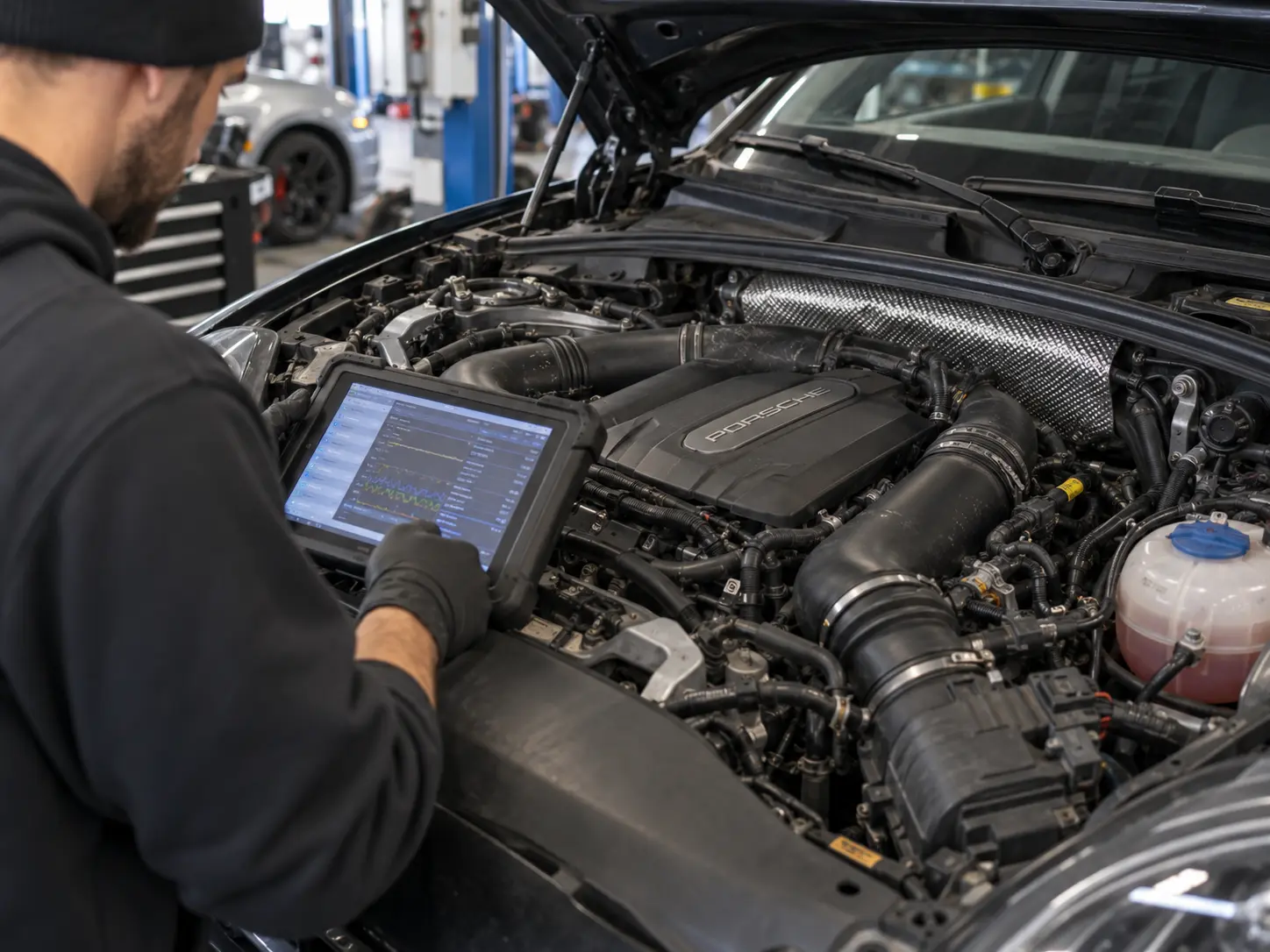
If your Porsche has started refusing to start, the key has begun fighting you, or the engine has ever cut out on the move, we’ll test the battery, the switch and the immobilizer before anything is ordered — and show you what we found. Motronix in Dania Beach has served Porsche owners from Fort Lauderdale, Hollywood, Miami, and the greater South Florida area since 1988.
Related Porsche Reading
- The Complete Guide to Common Porsche Repair Issues — cooling, suspension, brakes, ignition and electrical patterns, AOS and EVAP faults, and PDK service, with early signs for each.
- Porsche Losing Power or Stuck in Limp Mode — sudden versus gradual power loss, and how a protective strategy differs from an engine that simply cuts out.
- Automotive Electrical System Architecture — the six layers of load, voltage and module control that explain why electrical problems feel random.
- What Months of Sitting Do to a European Car in South Florida — what heat and humidity do to a parked car, and what to check before driving it again.
Porsche Ignition Lock Problems — Frequently Asked Questions
Why does my Porsche start only after I wiggle the key?
Can a failing ignition switch make a Porsche stall while driving?
Does replacing the ignition lock cylinder mean a new key?
Why won’t my Porsche recognize the key?
Can I drive a Porsche that sometimes won’t start, or should I have it towed?
Technical References
- Pelican Parts — technical article covering the two-piece 996 ignition lock and steering-lock assembly, its separately replaceable electrical switch and the later revision, and the change to an electro-mechanical steering lock on the 997: Porsche 911 Carrera Ignition Switch / Steering Lock Replacement (996, 997).
- Porsche Cars North America — Advanced Technical Information Bulletin 2114 (Part ID 9064), “Engine Will Not Start: Updating PVTS CU Software via Dealer Web Portal,” rev. June 23, 2021 (replaces TI 41/20), covering specified 2010–2021 models with Vehicle Tracking System (PVTS) equipment, false theft detection triggered by vibration, and the software-update remedy; hosted in the NHTSA service-bulletin archive: Porsche ATI 2114 — Engine Will Not Start: Updating PVTS CU Software.
- Pelican Parts — Porsche Boxster Ignition Switch Replacement, 986/987 (1997–08), technical article covering the two-piece 986 ignition switch, its part revision, and the change to an electro-mechanical steering lock and simpler switch on the 987.
- Porsche factory technical information (PIWIS diagnostic system and dealer service documentation) — immobilizer and steering-lock fault memory, guided tests and coding procedures.
- Robert Bosch GmbH — Bosch Automotive Handbook, sections on starting systems, vehicle electrical systems and immobilizers.