
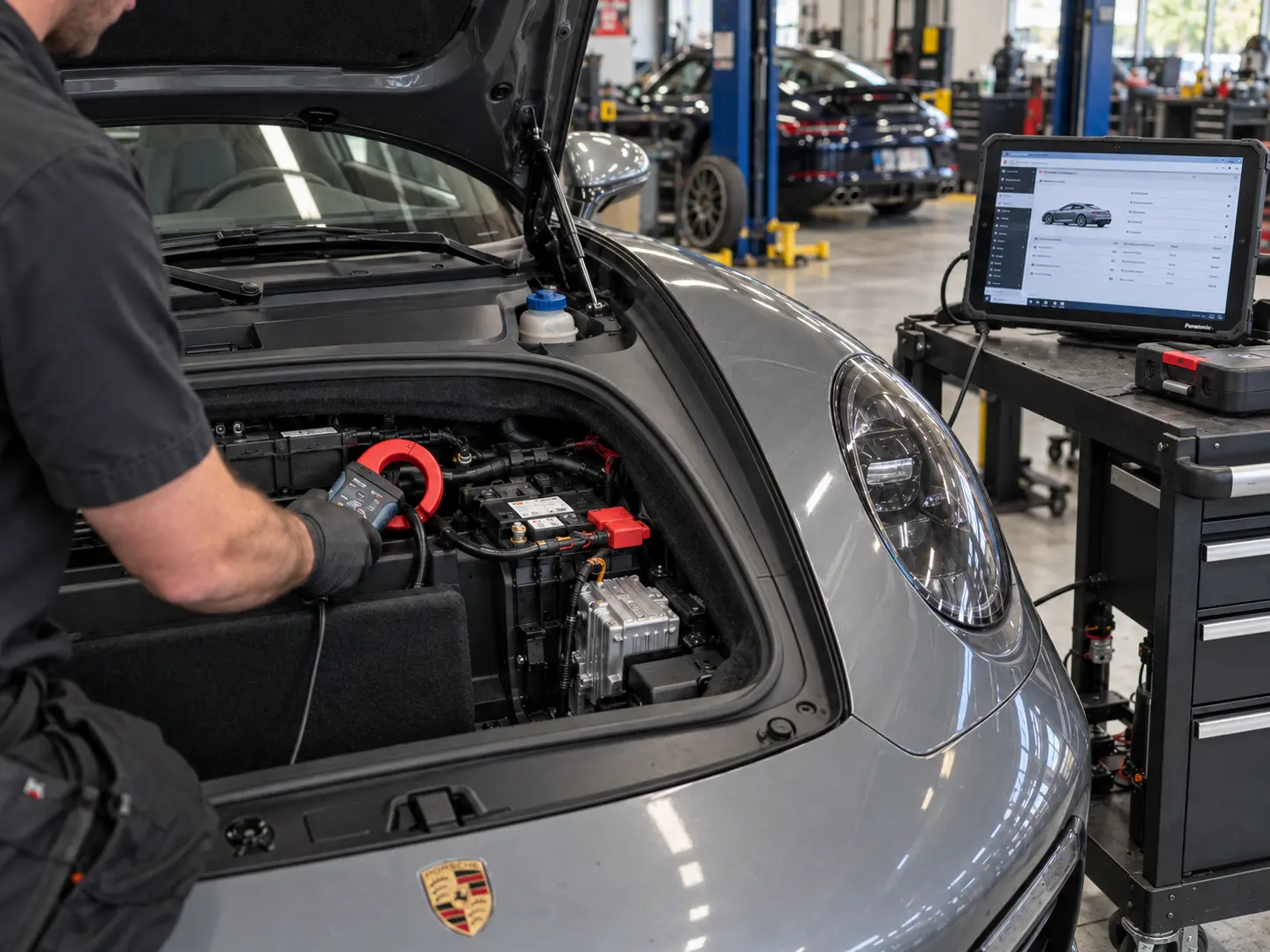

Car Battery & Starting System: How It Works, Why It Fails, and How It’s Tested
The 12-volt battery is no longer a simple box that cranks the engine. On many modern European cars it is monitored by an energy-management system, and a replacement may need to be registered; EVs also depend on a low-voltage battery, though its voltage, chemistry, and replacement procedure vary by model. This page explains how the battery and starting circuit work together, which battery types modern cars use and why they can’t be swapped freely, and how a no-start or weak-battery complaint is actually confirmed before anything is replaced.
What the battery and starting system do, in plain terms
The starting system has one job that sounds simple: turn the engine over fast enough, for long enough, for it to fire. To do that, the battery has to deliver several hundred amps for a few seconds through heavy cables to the starter motor — and the car has to give permission first. Once the engine runs (or, in an electric vehicle, once the high-voltage system is active), the charging system normally supplies most of the electrical demand, while the battery handles short peak loads and helps keep voltage stable. Most no-start and “dead battery” complaints come down to one of the links below, which is why the battery itself is only one of several things that get tested.
- The 12-volt battery: stores energy chemically and releases it on demand. Its ability to deliver high current for cranking and its reserve capacity are separate qualities — a battery can lose one before the other.
- Battery sensor: a small module on the negative terminal (BMW calls it the Intelligent Battery Sensor, or IBS) that measures current, voltage, and temperature so the car can estimate charge level and battery aging.
- Main cables and grounds: the high-current path from battery to starter and from engine back to body. Corrosion or a loose ground here can stop a car from cranking with a perfectly healthy battery.
- Starter motor and solenoid: the solenoid engages the starter gear with the flywheel and closes the high-current contacts; the motor then spins the engine. Worn solenoid contacts can cause a single click without cranking.
- Start authorization: before the starter is allowed to engage, the car has to recognize the key and confirm its starting conditions — on many push-button cars with automatic transmissions, that means park or neutral and the brake pressed. Interlocks vary by model, and a failure here can look like a dead battery from the driver’s seat.
- Charging source: an alternator on combustion engines, or a DC-DC converter fed by the high-voltage pack on hybrids and EVs. It refills the 12-volt battery — and if it underperforms, even a new battery can end up repeatedly discharged.
A starting complaint is a chain of permission, current, and mechanical engagement. Replacing the battery fixes only one link; proper diagnosis identifies which link actually broke.
Flooded, EFB, AGM, or lithium: which battery your car uses and why it matters
Modern cars ask far more of the 12-volt battery than older ones did. Start-stop can restart the engine repeatedly in stop-and-go driving, brake-energy recovery charges the battery in short, aggressive bursts, and dozens of modules keep drawing small amounts of power after the car is locked. Manufacturers responded by moving away from the conventional flooded battery toward designs that tolerate constant partial charging and discharging. The type your car left the factory with is specified for a reason.
- Flooded (conventional lead-acid): liquid electrolyte over lead plates. Inexpensive and adequate for cars without start-stop or heavy key-off loads, but it tolerates repeated partial discharge poorly. Still found on some older or base-trim models.
- EFB (Enhanced Flooded Battery): a reinforced flooded design with better cycling durability. Used on some entry-level start-stop applications where a full AGM battery isn’t specified.
- AGM (Absorbent Glass Mat): electrolyte held in fiberglass mats between tightly packed plates. Tolerates repeated cycling and high current better than a conventional flooded battery, which is why it is common across start-stop BMW, Mercedes-Benz, Audi, and Porsche models. It is also more sensitive to overcharging, so the charging system has to know it is there.
- Lithium-ion 12-volt / low-voltage batteries: lighter and longer-cycling, used as a factory fit on some Porsche models and on newer Tesla builds in place of the older lead-acid unit. A lithium battery has its own management electronics and charging requirements and is not interchangeable with lead-acid.
For conventional starter batteries, the key replacement specifications are cold cranking amps (CCA), the current it can deliver for cranking; amp-hour (Ah) capacity, the amount of charge it can supply under specified conditions; and the physical case size and terminal layout. EV low-voltage batteries follow the manufacturer’s own specification. On cars with energy management, the capacity and chemistry are also stored in software — so a battery that physically fits but differs in type or capacity can be charged incorrectly.
The safe default is to replace with the chemistry and capacity the car specifies, unless the manufacturer documents an approved alternative. Fitting a flooded battery where AGM is specified, for example, commonly shortens battery life and can disturb start-stop and charging behavior.
Related: European car battery failure in hot climates (which battery each brand typically uses, and why heat shortens AGM and EFB life).
Battery registration: why a new battery has to be introduced to the car
Energy-management software keeps a history of the installed battery and adjusts charging as it ages. If a new battery isn’t registered where the car requires it, the system may keep charging it like the old, worn one — which can shorten the new battery’s life or affect how energy management behaves.

No-crank or crank-no-start? The first question in every no-start
“It won’t start” describes two very different failures. In a no-crank, the engine doesn’t turn over at all — you hear silence, a click, or rapid clicking. In a crank-no-start, the engine spins normally but never fires. The battery and starting system are the prime suspects in the first case. In the second, they have mostly done their job, and the search moves to fuel, ignition, sensors, and the immobilizer — with one important exception covered below.
- Silence, dash lights dim or dead: commonly a discharged or failed battery, or a broken connection at the battery terminals or main ground. Measuring voltage at the battery and at the starter separates the two.
- Single click, dash stays bright: can point to a starter or solenoid fault, but bright dash lights don’t prove the battery can deliver cranking current, and a poor cable connection can do the same. Battery testing and voltage-drop measurement during a start attempt separate the causes.
- Rapid clicking: the solenoid engages, voltage collapses under load, it releases, and the cycle repeats. Usually a battery too weak to sustain cranking current, or a poor connection that behaves the same way.
- Nothing happens, key warning on the dash: the car hasn’t authorized the start. A key-recognition fault or a brake-switch or gear-position input can block cranking with a healthy battery. A weak key-fob battery can interfere with normal key detection; many models provide a backup starting procedure.
- Slow, labored cranking that eventually catches: the classic aging-battery pattern, especially on hot afternoons or after the car has sat. Also possible with a dragging starter, so cranking voltage and current are worth measuring.
- Normal cranking, no start: usually outside the starting system. The exception: if battery voltage dips low enough during cranking, it can disrupt the engine computer, fuel-pump control, or other systems needed for starting, so a weak battery can still cause a crank-no-start.
Sorting the complaint into the right branch before testing saves time and helps avoid a wasted repair — a new battery on a car whose real problem was a starter, a ground, or a start-authorization fault. For brand-specific walk-throughs, see our BMW no-crank vs. crank-no-start guide and our Mercedes no-start guide.
Related: alternator and starter repair (how Motronix tests and repairs the charging and cranking side when the battery isn’t the cause).
How a battery is actually tested — and why one reading isn’t a verdict
A battery can show a reassuring voltage at rest and still collapse the moment the starter asks for current. It can also look weak on a quick test simply because the car has been driven in short hops and never fully recharged. A useful battery test therefore measures more than one thing and is interpreted alongside the car’s own records. The checks below describe conventional 12-volt lead-acid starting systems; lithium low-voltage batteries and hybrid starting systems follow their manufacturer’s procedures.
- Resting voltage, after surface charge settles: a fully charged lead-acid or AGM battery typically rests around 12.6–12.8 volts. A lower resting voltage suggests reduced charge, but interpretation depends on battery type, temperature, and rest time — and voltage alone shows state of charge, not health.
- Conductance or load test with the correct battery data: the tester has to be set for the battery’s actual type and rating. Testing an AGM battery as flooded, or entering the wrong CCA figure, can produce a misleading pass or fail.
- Cranking voltage: as a general reference, battery voltage during cranking is commonly expected to stay above roughly 9.6–10 volts, though interpretation depends on temperature, test conditions, and the vehicle’s specification. A deeper dip suggests a weak battery or an unusually high starter draw.
- Voltage drop across the cranking circuit: measured on the positive cable and the ground path while the engine cranks. Excessive drop under load identifies resistance in a cable, connection, or ground; the battery’s own condition still has to be assessed separately.
- Charging output under load: whether the alternator or DC-DC converter actually refills the battery with headlights, blower, and defrosters running. A chronically undercharged battery may produce poor test results and deteriorate prematurely.
- Energy-management history: on many modern cars, a capable scan tool can read stored undervoltage events, battery state estimates, and whether the last replacement was registered — information a handheld tester can’t see.
If the battery tests healthy but keeps going flat after the car sits, the next question is what is drawing power while the car should be asleep — a different test, covered in our guide to electrical system architecture, load, and module control.
Related: diagnostic methodology (why measured evidence comes before replacing parts, and how test results are interpreted).
Start-stop, auxiliary batteries, and the 12-volt system in hybrids and EVs
The 12-volt battery now sits inside larger systems that change how it fails and how a failure shows up. Three of them account for a large share of the battery questions we hear.
Start-stop as an early battery gauge
Before a start-stop system shuts the engine off at a light, it checks whether the battery can be trusted to restart it, alongside conditions like cabin climate demand and engine temperature. As a battery ages, the car quietly stops allowing auto-stop — often weeks or months before cranking feels slow. A start-stop system that has stopped engaging can be normal in some conditions, but a persistent pattern is worth testing. Our Mercedes Start/Stop Disabled guide explains what the car checks and how to tell normal behavior from a battery limit.
Auxiliary batteries and 48-volt mild-hybrid systems
Some cars carry a second, smaller battery or a capacitor-based voltage support unit to keep critical systems stable during engine restarts. Several newer BMW, Mercedes-Benz, and Audi models also use a 48-volt mild-hybrid system with its own battery and a DC-DC converter that feeds the 12-volt side. On these cars, a warning that names an auxiliary battery — or a start-stop fault with a healthy main battery — can trace to a component a basic battery test never touches.
The low-voltage battery in electric vehicles
An EV has no starter, but it still depends on a low-voltage battery to power the computers that wake the car, unlock the doors, and close the contactors that connect the high-voltage pack. When that battery weakens, the car may not wake at all, or it may throw a burst of unrelated warnings. Our Tesla 12-volt battery warning cascade guide covers how that pattern looks, and our Tesla won’t-wake-up triage guide covers what to try before calling a shop.
Across all three, the same rule applies: confirm which battery or power-supply component is actually at fault before replacing anything, because these systems produce overlapping symptoms.
When to replace the battery — and when the battery isn’t the problem
A new battery can be the right repair, but it can also hide the real fault for a few weeks, which makes the eventual diagnosis harder. These are the patterns that separate a worn-out battery from a battery that is a victim of something else.
- Replace — testing confirms the battery has failed: after charging as the test procedure requires, a battery that fails the applicable health or performance test should be replaced. Cranking ability and reserve capacity are different measures, and not every handheld tester checks both.
- Plan replacement — age plus heat exposure: heat is one of the biggest drivers of battery aging, and in our experience AGM and EFB batteries in South Florida often reach the end of their useful life in around three to four years. A battery several summers old that is starting to show early signs is a reasonable candidate for planned replacement.
- Don’t replace yet — discharged, not failed: short trips, long parking, or a light left on can drain a healthy battery. A controlled recharge and retest often shows the battery is fine.
- Address the charging fault: if the alternator or DC-DC converter isn’t refilling the battery, a new battery may also end up discharged. Repeated discharge can also damage the battery, so recharge and retest it after the cause is fixed.
- Investigate the parked-car draw: a module that never sleeps drains any battery, so the fix starts with finding the circuit. Repeated discharge can also damage the battery, so recharge and retest it after the cause is fixed.
- Check the last replacement: an earlier battery installed with the wrong type or capacity, or never registered, can be the reason the current one is failing early.
When replacement is the right call, the complete job includes the correct battery type and capacity, registration or coding where the car requires it, a check of the terminals and ground, and confirmation that the charging system is doing its part.
Related: maintenance strategy (planning wear items like batteries around how and where a car is driven, not just the calendar).
Jump-starting, battery maintainers, and cars that sit
How a car is jump-started or kept charged matters more on modern vehicles than it used to. Sensitive electronics, battery sensors, and lithium chemistries all change the safe way to do it.
- Use the designated jump points: many European cars have remote jump-start terminals under the hood even when the battery sits in the trunk or under a seat. The owner’s manual shows where they are.
- Ground to the specified point: connecting the negative lead directly to the battery terminal can bypass the battery sensor on cars that have one. Use the ground point the manual specifies.
- Check the procedure for lithium batteries: lithium low-voltage batteries can have their own jump-start rules. Follow the manufacturer’s procedure rather than general jump-start habits.
- Match the maintainer to the battery: for vehicles that permit maintenance charging, use a manufacturer-approved maintainer matched to the battery’s chemistry and nominal voltage, connected at the specified points. An old fixed-voltage trickle charger can overcharge an AGM battery.
- A jump is a symptom, not a fix: a battery that needed a jump has either been drained or is failing. Testing it afterward tells you which.
- Weekend and seasonal cars: modern cars draw a small amount of power even when parked. A car that sits for weeks without a maintainer can drain a healthy battery, and repeated deep discharge shortens its life.
If a car needs repeated jump-starts, it is time to test the battery, the charging system, and parked-car draw together rather than continuing to jump it.
Battery & Starting System Testing in the Fort Lauderdale Area
If your car is cranking slowly, clicking, losing start-stop, or needing jump-starts, a proper test can tell you whether it’s the battery, the starter, the charging system, or something drawing power while the car sleeps. At Motronix, our ASE-certified technicians test the battery against its actual type and rating, measure cranking and charging under load, and register or code a replacement battery with factory-level tools when the car requires it — see our battery and electrical repair service or browse all of our services. We service BMW, Mercedes-Benz, Audi, Porsche, and Tesla vehicles in the Fort Lauderdale, Hollywood, and Miami areas.
Car Battery & Starting System — FAQs
How long does a car battery last in South Florida?
Do I have to register or code a new battery?
Can I replace an AGM battery with a regular flooded battery?
My car clicks but won’t start. Is it always the battery?
Is it safe to jump-start a modern European car or an EV?
Why did my start-stop stop working before my battery died?
References
The concepts on this page reflect widely accepted automotive electrical principles, battery industry rating standards, manufacturer service procedures, and patterns we see in European cars and Teslas in South Florida. The sources below are the technical foundation for battery ratings, testing, and replacement requirements.
- SAE J537 — Storage Batteries — SAE International standard defining test methods for 12-volt automotive starter batteries, including the cold cranking amps (CCA) rating used to size a replacement.
- EN 50342-1 — Lead-acid starter batteries: general requirements and methods of test — The European standard for starter battery ratings and testing, including the CCA test method commonly printed on European-market batteries.
- Battery Council International (BCI) — North American battery industry association that publishes battery group sizes and technical guidance on battery ratings, testing, and recycling.
- Banner Batterien — How To: Registering Start-Stop Batteries — Battery manufacturer guidance on why vehicles with battery energy management need a replacement battery registered, and how registration differs from systems that learn a new battery on their own. Available at: bannerbatterien.com — Registering the battery.
- Tesla Model Y Owner’s Manual — Jump Starting — Tesla’s procedure for jump-starting the low-voltage battery, with separate instructions for lithium-ion and lead-acid low-voltage batteries. Available at: tesla.com — Model Y Jump Starting.