
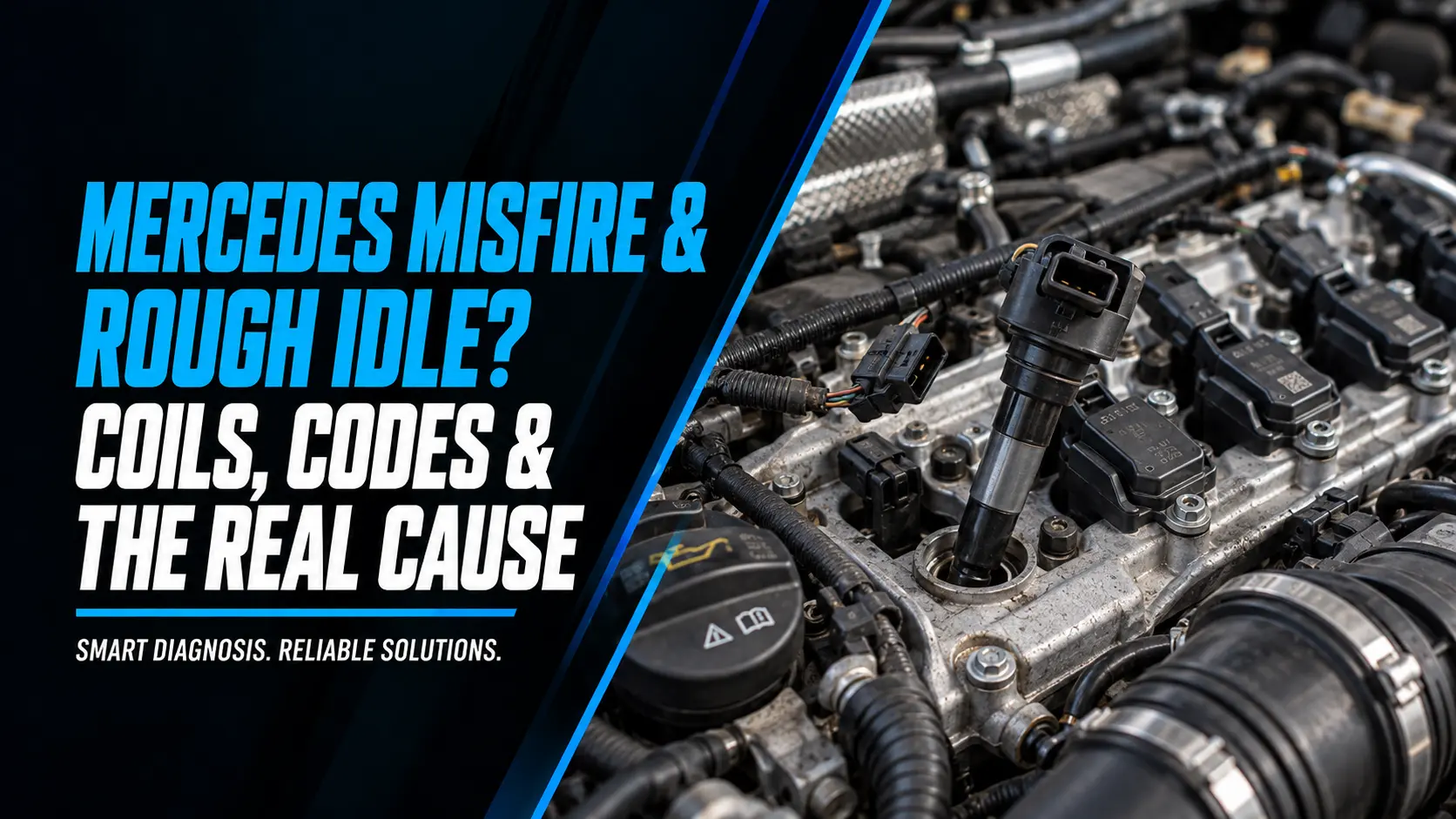
You’re sitting at a light and the car isn’t right. The idle has a shake it didn’t have last week, there was a stumble pulling away from the last stop, and the check-engine light just started flashing. On M274-, M276-, and M278-powered C-, E-, GLC, and GLE models, one of the first things we’d suspect is an ignition coil.
As an independent Mercedes specialist in the Fort Lauderdale area, we see this set of symptoms all summer. The first check is usually whether one of the ignition coils has started breaking down.
- A failed coil is an early suspect. On the M274, M276, and M278 cars we diagnose, a single coil-on-plug is one of the most common causes of a cylinder-specific misfire.
- Heat matters. Heat-soak is a known stress on coil insulation, and we regularly see heat-aged coils on daily-driven local cars.
- A flashing light is different from a steady one. Stop treating it like a routine appointment — details below.
- You often don’t need the full set. Per-cylinder misfire data identifies the cylinder, so we test that one instead of replacing everything.
- Not every misfire is ignition-related. An intake leak, a weak MAF sensor, or intake-valve carbon can look like a coil.
- A smooth engine that still shakes points elsewhere. No light and an even-sounding engine usually means motor mounts.
Why is my Mercedes shaking at idle or stumbling — and is it a misfire?
If the engine sounds uneven at idle and the check-engine light is on or flashing, a misfire is one of the first things to check — one cylinder isn’t firing cleanly.
What owners usually notice first is a shake at a stoplight that eases once the revs come up, then a hesitation on light throttle, then a light that may start flashing under load. The useful question is “which cylinder, and why?”
One distinction first. A misfire makes the engine itself run unevenly — you hear it in the exhaust note and see the tach wander. A worn motor mount is different: the engine keeps running smoothly, but its vibration gets into the body, so the car shakes with no light on. If that sounds more like your car, start with our Mercedes motor-mount guide instead.
Why is a bad ignition coil the early suspect on M274, M276, and M278 engines?
In the M274, M276, and M278 cars we diagnose, a single failed coil-on-plug is one of the most common causes of a cylinder-specific misfire — and repeated under-hood heat can accelerate coil aging.
These engines use one ignition coil per cylinder, mounted directly over each spark plug — four on the M274, six on the M276 V6, eight on the M278 V8 — which puts the coil in one of the hottest spots on the car. Repeated heat cycling ages the resin and winding insulation inside it; eventually the coil can’t deliver clean spark, and its cylinder starts missing. It’s a pattern we see over and over — one failed coil, the others still testing normally — and one of the most common reasons a car comes to us for Mercedes engine repair work.
South Florida doesn’t help. Cars sit in hot parking lots, crawl through traffic with little airflow, and stay heat-soaked after they’re shut off. That repeated thermal cycling is hard on ignition coils, and we regularly see heat-aged coils on local cars — which is why one failed coil is often a preview of the rest.
What fault codes come with a Mercedes misfire — and what do P0300, P0301, and a pending code mean?
The P030x family is the OBD-II misfire code set: P0300 is a random or multiple-cylinder misfire, and P0301 through P0308 name a specific cylinder by number.
The engine computer detects a misfire by watching crankshaft speed — a cylinder that doesn’t fire fails to accelerate the crank the way its neighbors do, and that miss gets counted. The codes that result are a starting point, not a diagnosis:
- P0300: The computer detected a random or multiple-cylinder misfire pattern rather than assigning the fault to one cylinder. Shared causes such as an air leak or fuel-delivery problem can produce it, but the code by itself doesn’t identify the cause.
- P0301 through P0308: The last digit is the cylinder number. On these engines a single-cylinder code paired with live misfire counts on that same cylinder points strongly at the coil or plug sitting on it.
- Pending vs. stored: A pending code means the monitor has detected a fault condition that hasn’t yet met every criterion for a confirmed code. A confirmed code has met the system’s threshold for storage, and depending on the fault and monitor logic the light may be commanded on; a severe, catalyst-damaging misfire can make the light flash during the very drive it happens in.
- Coil-circuit codes: A failed coil can also set a P0351–P0358 ignition-coil circuit code. Those codes identify coils as A through H, so we confirm the actual cylinder mapping for the car rather than assuming it. Fuel-trim changes can show up too, depending on how the engine is running — we read those alongside the misfire counts to make sure a shared cause isn’t showing up as one cylinder.
Codes narrow the search. The live-data read in the bay is what finishes it.
Why does a Mercedes misfire rarely need a full set of coils and plugs?
Because live data identifies the cylinder that’s misfiring, so we can test that cylinder instead of replacing every coil and plug by default.
The shortcut is to replace every coil and plug and hope the misfire disappears — which can mean paying for parts that were never the problem. With factory-level Mercedes diagnostics we watch per-cylinder misfire counters in real time and see the count climb on one cylinder while the others sit at zero.
On a confirmed single-coil failure we replace the failed coil and inspect the plug underneath it — if it’s worn, fouled, or due by mileage, that gets replaced too — then clear the fault codes and road-test the car while watching the misfire data.

One caveat: on the four-cylinder M274 the coils sit right on top and a single-coil repair is quick, but access gets harder as the engine gets bigger — on the M276 V6 the standard service procedure involves removing the intake manifold for access, and on the M278 V8 the rear cylinders are tight work next to the firewall. Once the car is open we’ll tell you plainly whether doing the set in that visit is the better value. If several coils are actually failing, we’ll show you that in the test results.
How does a Mercedes specialist confirm which cylinder is misfiring — and that it’s the coil?
Live data, a short road test, and — when the picture still isn’t clear — a coil swap-test.
- Per-cylinder misfire counters: The engine control module tracks misfire events for each cylinder individually. Watching those counters with the engine running tells us which cylinder is missing right now and whether the problem is steady or intermittent.
- Fuel trims and ignition timing: We read short- and long-term fuel trims per bank and the timing the computer is commanding. If the trims are way off or follow a pattern across a bank, we start looking harder at an air leak, MAF problem, or fuel-delivery issue instead of blaming one coil.
- Road test with the tool connected: Idle data is useful; cruise-and-load data confirms it. We watch counters stay flat on healthy cylinders and climb on the suspect one during normal driving.
- Coil swap-test: Where the picture is still unclear, we move the suspect coil to a known-good cylinder. If the misfire follows the coil, it’s the coil. If it stays on the original cylinder, we look at the plug, the injector, or compression on that cylinder instead.
- Plug inspection: A coil that has been misfiring for a while often fouls the plug beneath it, so we check gap, electrode wear, and deposits before anything goes back together.
Why in that order: the counters and trims cost nothing and are live while the car is still running, the road test confirms them under real load, and the swap test is the only step that touches hardware — so it comes last, and only when the data hasn’t already settled it.
What are the look-alike causes when it isn’t the ignition coils?
Before replacing a coil, we also check for a few problems that can look the same from the driver’s seat:
- Vacuum or intake air leak: A split PCV hose, cracked intake boot, or leaking manifold seal lets unmetered air in, so the fuel trims swing positive — the computer adding fuel to correct a lean mixture. Often worst at idle, when vacuum is highest.
- Mass-airflow (MAF) sensor: A contaminated or failing MAF can skew the air measurement for the engine as a whole, which usually shows up in the fuel trims rather than as a clean one-cylinder fault.
- Direct-injection carbon: All three of these engines inject fuel straight into the cylinder, so fuel never washes the intake valves and deposits can build at higher mileage. When deposits contribute, one possible pattern is a rough cold start that improves as the engine warms.
If the main complaint is lost power on a highway merge but the engine idles smoothly, we’d start looking at the boost side instead — see our Mercedes turbo boost-loss guide.
When is a rough-running Mercedes actually a cam-adjuster or a high-pressure fuel pump problem instead?
If the pattern doesn’t fit an ignition problem, cam timing and fuel pressure are two other areas we may need to check.
- Camshaft adjuster: Think timing-related codes rather than P030x, roughness concentrated after cold starts, and sometimes a brief rattle at startup. If that’s your pattern, the M276 camshaft-adjuster guide is the post you want, not this one.
- High-pressure fuel pump: Think long cranking before a start, an intermittent no-start, and fuel-pressure codes rather than per-cylinder misfires. If the complaint is “it won’t start” more than “it stumbles after it starts,” read the Mercedes fuel pump guide instead.
What’s the difference between a flashing check-engine light and a steady one on a Mercedes?
Flashing means an active misfire severe enough to damage the catalytic converter — get the car to the shop without a long drive.
It means misfire counts are climbing fast enough that unburned fuel is reaching the catalytic converter, which doesn’t tolerate that for long. Continuing to drive with an active misfire can overheat and damage the converter, which is a much more expensive repair than a coil. Reduce load and avoid continued driving: if the engine is shaking hard, bucking, or badly down on power, shut it off and tow it; otherwise arrange service as soon as practical.
A steady light on a car running mostly fine isn’t that emergency — you have time to book an appointment.

Rough idle, stumble, or a flashing check-engine light on your Mercedes? Bring it in and we’ll find out what’s actually causing it. Motronix in Dania Beach serves Mercedes owners from Fort Lauderdale, Hollywood, Miami, and across South Florida. Call or schedule below.
Related Mercedes Reading
- Mercedes Check Engine Light: Common Causes — when the light is on and it isn’t a misfire.
- M276 Camshaft Adjuster Failure & Cold-Start Rattle — if you have timing-related codes or a cold-start rattle.
- Mercedes Fuel Pump Failure: Silent Signs on M274, M276 & M278 — for long-crank, no-start, and fuel-pressure symptoms.
- Mercedes Engine Vibrating at Idle? Check Your Motor Mounts — if the engine runs smoothly but the body vibrates at idle.
- Motronix Diagnostic Methodology — how we work a fault from symptom to confirmed cause.
- Electrical Load & Control Architecture — where the coil-on-plug circuit sits in the car’s electrical system.
Frequently Asked Questions — Mercedes Misfire and Rough Idle
Is it safe to keep driving my Mercedes with a flashing check-engine light?
No — ease off, pull over when it’s safe, and get the car to a shop without a long drive. A flashing light means the engine computer is seeing a misfire severe enough that unburned fuel is reaching the catalytic converter, and continuing to drive on it can overheat and damage the converter — a much more expensive repair than a coil.
Should I replace all the Mercedes ignition coils at once if one is bad?
Not automatically. If testing confirms one failed coil, replacing only that coil is often reasonable. On engines where coil access takes substantial labor — the M276 V6 in particular — replacing an aging set while the engine is already opened up can be the better value. We’ll show you both options for your engine and let you choose.
How long do Mercedes ignition coils last in South Florida?
There isn’t a published replacement interval for coils on these engines. Heat and repeated thermal cycling are two of the stresses that age them, and on the daily-driven South Florida cars we service, heat-aged coils are a regular finding. Because the remaining coils have been through the same mileage and heat cycles, it’s not unusual for another one to need attention later.
Can I diagnose a Mercedes misfire with a cheap OBD-II reader?
Partly. A generic reader can usually pull the P030x misfire codes, generic coil-circuit codes, and basic fuel-trim data. What it may not provide is Mercedes-specific live misfire counters, enhanced control-unit data, or the test functions needed to confirm why that cylinder is misfiring — the part that separates a bad coil from an air leak, a MAF problem, or carbon buildup.
If my Mercedes shakes at idle but there’s no check-engine light, is it still a misfire?
Probably not. A misfire bad enough to shake the car at idle usually sets at least a pending P030x code. If the engine runs smoothly and the car still shakes, worn motor mounts are the more likely cause; our Mercedes motor-mount guide covers that diagnosis.
What does a Mercedes misfire diagnostic cost at an independent shop?
It varies by shop and by what the diagnostic includes. What matters is what the diagnostic actually includes. Pulling a code is quick; confirming the cause may mean checking live misfire data and fuel trims, testing the suspect cylinder, and road-testing the car. Call Motronix for a current estimate on a Mercedes misfire diagnostic for your specific model.
Technical References
- Delphi Technologies — Defective Ignition: Diagnosis, Cause, Knowledge — components-supplier technical reference on why ignition coils fail, including the thermal load on coil-on-plug (pencil) coils that shortens their service life.
- Cars.com — What Is an Engine Misfire and What Causes It? — plain-language explainer on how a misfire happens, the ignition coil as a common cause, and why a flashing check-engine light signals a catalytic-converter-damaging misfire.
- Mercedes-Benz factory workshop information (WIS / XENTRY — manufacturer service documentation) — ignition-system diagnosis and live-data reference for the M274, M276, and M278 engine families.
- Bosch Automotive Handbook (Robert Bosch GmbH) — ignition-system theory, coil-on-plug design, and the thermal aging of coil insulation.
- U.S. EPA and California ARB on-board diagnostic regulations — the OBD-II requirement that a catalyst-damaging misfire illuminate a flashing malfunction indicator lamp.