
You’re a few thousand miles into the service interval and the low-oil warning comes on. You add a quart, drive another few weeks, and it comes back. No puddle in the driveway, no smell, nothing obviously wrong — but the car is clearly using oil.
We hear this a lot from the Fort Lauderdale-area owners who bring us their 3-Series, 5-Series, X3, and X5 for BMW service. Some oil consumption is normal, and BMW’s published limit is higher than many owners expect. But if your car has suddenly started needing oil between changes, it’s worth finding out why.
- BMW allows more oil consumption than many owners realize. BMW’s published service specification allows up to about 1 quart per 750 miles on non-Motorsport engines — an upper limit, not what a healthy engine should use.
- Burning oil is different from leaking oil. Internal consumption usually leaves no puddle; a leak often does — and we rule leaks out first.
- These are the four main causes we check for. The PCV/CCV valve, valve-stem seals, turbo oil seals, and piston-ring wear — in our shop, roughly in that order.
- Blue smoke at startup narrows the search. A brief puff after sitting often points to valve-stem seals, though a failed PCV diaphragm can produce the same thing.
- We don’t recommend internal engine repairs without confirming the problem. Ventilation, intake, and turbo checks come before any ring diagnosis.
- Certain BMW engines have known oil-consumption issues. Certain N63 generations carry BMW consumption programs; on the B58, a failed valve-cover PCV diaphragm is a documented cause, and some B58 cars have extended warranty coverage for it.
Is it normal for a BMW to use oil between oil changes?
Yes, within a range that surprises most owners — BMW’s published service guidance allows up to about 1 quart per 750 miles on non-Motorsport engines.
That figure comes from BMW’s own service bulletin on engine oil consumption. It’s an upper service specification, not what every healthy BMW should use — many go a full interval with little or no top-up. What tells us something is a change: a B58 that never asked for oil and now wants a quart every 1,500 miles deserves investigation even though that rate is inside BMW’s limit, while an N63 that has used a quart every 2,000 miles for years is inside its own normal.
Which BMW engines use the most oil — B58, B48, N20, or N63?
Oil-consumption problems vary by engine — the N63 has the documented consumption history, and each engine family deserves a different first check.
- B58 (3.0L turbo inline-six): A failed PCV diaphragm in the valve cover is a documented issue on certain B58 engines, and it’s what we check first — though not every B58 oil-use complaint is PCV-related. Under BMW SIB 01 14 23, eligible B58M-powered cars — certain 340i, 540i, X3 M40i, and other models — have extended coverage of 15 years or 150,000 miles for qualifying PCV failures. It’s a warranty extension, not a recall, and eligibility depends on the VIN, so confirm coverage with a BMW dealer.
- B48 (2.0L turbo inline-four): Same valve-cover PCV layout; we check crankcase ventilation, leaks, and operating history before considering internal wear.
- N63 (4.4L twin-turbo V8): Certain generations have documented consumption problems, and its turbos sit in the hot valley between the cylinder heads. BMW has established service programs and settlement benefits for certain N63TU1-equipped vehicles — eligibility depends on the specific model, production date, and VIN, not simply the model year.
- N20 (2.0L turbo inline-four — in this range, the F30 3-Series through 2016): Like the others, an N20 can use oil through crankcase-ventilation problems, external leaks, or internal wear. We check the maintenance history and symptoms before deciding whether piston-ring testing is warranted.
Driving habits and oil condition also affect consumption — short trips that never fully warm the engine, sustained high-rpm running, and long drain intervals all push it up — so we look at how the car has been driven and serviced, not just which engine it has.
What are the signs your BMW is burning oil?
Four things an owner notices from the driver’s seat — they help us decide what to inspect first.
What owners usually notice first isn’t smoke; it’s the low-oil message coming back sooner than it used to. The other patterns:
- A low-oil warning that keeps returning between changes: If the interval is stable, you may be inside normal consumption; the question is how fast.
- A blue puff on cold startup that clears in seconds: Often oil that seeped past the valve-stem seals overnight — but a ruptured PCV diaphragm produces the same cold-start smoke, so the timing is a clue, not a confirmed cause.
- A whistle or howl from the engine at idle: A classic sign of a torn crankcase-ventilation (PCV/CCV) diaphragm. A faint oil smell after driving can go with it, though a smell alone can also be an external leak on a hot surface.
- Blue smoke under hard acceleration or sustained highway load: Can point toward turbocharger oil seals or ring wear — a reason to book an inspection, not to assume the worst.
One check before any of this: is the oil leaving the engine, or going through it? A puddle, a film on the undercarriage, or oil smell on hot exhaust means an external leak; our BMW oil-leak guide covers that side. A dry driveway doesn’t fully rule a leak out (some leaks collect on the underbody covers or appear only while driving), so we check for leaks first, then investigate internal consumption — the rest of this post.
Can a BMW turbo oil seal cause oil consumption with no leak underneath?
Yes — worn turbo seals send oil into the intake or exhaust stream rather than onto the ground, which is why it looks like consumption with no source.
The turbocharger’s shaft spins on a continuous feed of pressurized engine oil, with sealing arrangements at each end that keep oil out of the intake and exhaust. If that sealing system is damaged, or if crankcase pressure or oil drainage isn’t right, oil can enter the intake or the exhaust: on the intake side it travels through the charge pipes and intercooler before reaching the cylinders; on the exhaust side it burns in the hot exhaust stream. So oil around a turbo doesn’t automatically mean the turbo has failed. Blue smoke under boost is the common presentation, though it can also show at idle. Repeated high temperatures contribute to oil degradation and turbo wear, particularly if lubrication or cooling is compromised — and the N63’s twin turbos sit in the hot valley between the cylinder heads, not outside the block like the B58’s single turbo.
- How we confirm it: We inspect the charge pipes and intercooler for excessive oil, check the crankcase-ventilation system, check the turbo’s oil supply and return lines, and check the shaft for play. BMW’s own crankcase-ventilation bulletin warns that a faulty pressure-control valve puts oil in the intercooler and gets misdiagnosed as a bad turbo, so we confirm the source first.
- Scale of the fix: Turbocharger service or replacement — more labor on the N63 because of the valley location, but still a bolt-on component.
What’s actually burning the oil inside a BMW engine?
Four internal causes account for most of the oil-consumption cases we see — in our shop, roughly in this order: a failed PCV/CCV valve, worn valve-stem seals, turbocharger oil seals, and worn piston oil-control rings.
What we test next depends on the symptoms and what the initial inspection shows. We work the list in that order because the common causes are also the ones on top of the engine, so we rule them out first. In our experience, most BMW oil-consumption cases come down to the first two. Either way, proper BMW engine repair starts with a proper diagnosis.
How does a failing PCV/CCV valve make a BMW burn oil?
The crankcase-ventilation valve regulates how blow-by gases return to the intake; when its diaphragm tears, the engine pulls oil mist out of the crankcase and burns it — often with no visible smoke.
Every engine pushes some combustion gas past the rings into the crankcase. The PCV (BMW calls it the CCV) routes that gas back into the intake, and a diaphragm inside it controls the vacuum so the system carries vapor rather than oil. On the B58 and B48 the valve is built into the valve cover, and after enough heat cycles the diaphragm ruptures. A torn diaphragm may produce a whistle or howl at idle (a change in that noise with the oil cap opened is a clue, not a test), and BMW’s own bulletin on the B58 valve also lists blue or white smoke after a cold start and sometimes a misfire or reduced-power mode.
- Symptom pattern: Steady consumption with little or no smoke, sometimes a rough idle after a highway run, and the idle whistle if the diaphragm has torn.
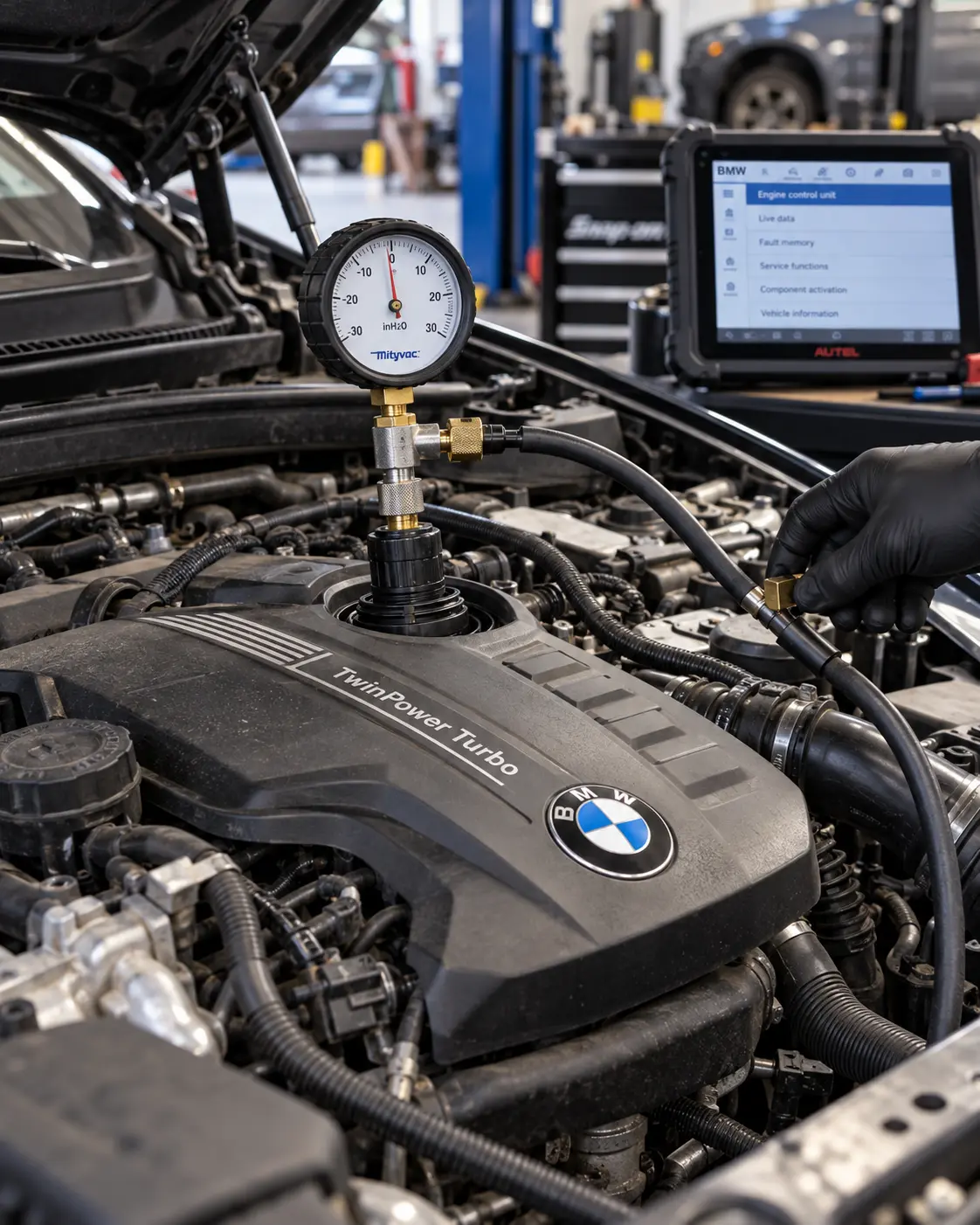
- How we confirm it: We measure crankcase pressure against BMW’s specification for the engine, inspect and smoke-test the ventilation path for leaks, review fuel-trim readings when relevant, and check the intake tract for excessive oil.
- Scale of the fix: Depends on the engine version: on some B48 and B58 applications it’s the valve-cover assembly; for the B58M, BMW has a pressure-control-valve repair kit, and eligible cars carry the extended warranty noted above. Either way it’s a top-of-engine repair.
In our shop this is the most common cause of BMW oil consumption, and the one most often misread as internal engine wear — which is why we check the ventilation system before we talk about anything inside the engine.
Does blue smoke at startup mean valve-stem seals or piston rings?
A brief blue puff after the car has been sitting can point to worn valve-stem seals; oil consumption that continues regardless of driving conditions — sometimes with no visible smoke at all — is more consistent with the rings. Smoke timing is a clue, but it doesn’t confirm the cause.
Valve-stem seals keep oil in the valvetrain while letting each valve slide in its guide. As they age and harden, oil passes along the stems while the car sits, pools on the back of the valves, and burns off on the first start or after extended idling; once the engine is running the smoke stops. Worn valve-stem seals are a known concern on certain N63 engines — but a PCV fault can produce a similar cold-start puff, so we don’t condemn seals on smoke alone.
Oil-control rings do the opposite job — scraping oil off the cylinder wall on every stroke. If they wear or become stuck in their grooves from carbon buildup, they leave too much oil on the cylinder walls, and that oil burns in the combustion chamber — so the consumption doesn’t follow a startup or a boost pattern, and it can happen with little visible smoke and normal compression readings. On the engines in this range it’s the last cause we expect to find.
- How we tell them apart: A controlled cold-start observation, clearing the ventilation system first (a crankcase-pressure test where the engine supports it), then compression and leak-down testing. Those two tests evaluate cylinder sealing and some kinds of ring and cylinder wear, but not the whole story — oil-control rings can pass oil while compression reads normal — so we weigh them with the measured rate, the intake and turbo findings, and the service history before recommending internal engine work.
- Scale of the fix: Valve-stem seals can be substantial cylinder-head work, but they don’t mean engine replacement. Rings are internal engine repair; on an N63TU1-equipped car, BMW’s settlement and service programs are worth checking by VIN first.
How does a shop measure BMW oil consumption before condemning the rings?
By measuring it rather than estimating it: rule out external leaks, confirm the correct oil and fill level, then measure how much oil the engine uses over a documented interval — BMW’s own procedures often use roughly 750 to 1,000 miles.
That’s how BMW dealers run a consumption test, and it’s where we start when we run a BMW diagnostic for oil consumption. From there, the symptoms and the maintenance history decide the tests: crankcase pressure on a B48 or B58, inspection and a smoke test of the ventilation system on an N63, and compression and leak-down only when we suspect internal wear. For more on how we approach diagnostics in general, see our diagnostic methodology page.
What can I check at home before booking a BMW oil-consumption diagnosis?
You can’t run a compression test in the driveway, but four observations make the shop visit faster.
- Document the top-up interval. Note the mileage each time the level drops a quart, and do it twice — on most B48 and B58 cars that’s the electronic oil-level check in iDrive, since there’s no dipstick. “A quart every 1,800 miles, steady” tells us far more than “it uses oil.”
- Watch the first startup of the day. Stand behind the car. A blue puff that clears in seconds, smoke while driving under load, or no smoke at all are different patterns — note which you see, and whether there’s a whistle at idle.
- Park on clean pavement overnight. Drops or film underneath in the morning means an external leak — the other branch — and our oil-leak guide is the right read. A dry driveway is useful information, but it doesn’t rule a leak out.
- Check your oil-change cadence. Oil condition and maintenance history affect how these components age; our BMW milestone maintenance guide covers where to land on service cadence in this climate.
Those notes help us choose which tests to run first.
When is BMW oil consumption urgent?
The oil use itself is rarely the emergency — running the engine low on oil, or losing oil pressure, is.
Not every one of these needs the same response:
- A red oil-pressure warning or a message to stop the engine: Pull over safely, shut the engine off, and don’t drive on until it’s been evaluated. This is different from a low oil-level message asking for a top-up.
- Blue smoke that’s new and getting worse week over week: Book an inspection. Finding the cause early may help prevent additional damage.
- A low oil-level warning on a repeatable interval: Not urgent, but worth measuring. Top up, note the mileage, and bring us the number.
- Several low-level warnings in a row that you’ve been driving through: This is what damages engines — oil starvation takes out turbo and engine bearings, far more expensive than any top-of-engine cause. Top it up now and book.
- No warning, but your own oil-level check reads low: Treat it like a warning — don’t wait for the message before topping up.

Low-oil warnings between changes, blue smoke on startup, or steady oil use you want measured honestly? We’ll measure the consumption and check the likely causes before recommending any repair. Motronix in Dania Beach serves BMW owners from Fort Lauderdale, Hollywood, Miami, and across South Florida. Call or schedule below.
Related BMW Reading
- BMW Oil Leak Problems: Symptoms, Sources & Repair — the external-leak branch, if there’s oil under the car.
- BMW Maintenance at 60k, 90k & 120k — where oil-change cadence lands in South Florida heat.
- BMW Limp Mode & Reduced Power on N20, B48 & B58 — if the oil use comes with a power-loss warning.
- BMW N20 Timing Chain Failure — the other wear item to check on a higher-mileage N20.
- Motronix Diagnostic Methodology — how we work a fault from symptom to confirmed cause.
- Oil Leak Diagnosis & Seal Integrity — how we trace where oil is migrating when more than one path is possible.
Frequently Asked Questions — BMW Oil Consumption and Burning Oil
How much oil consumption is “too much” on a BMW turbo engine?
BMW’s own published specification allows up to about 1 quart per 750 miles. That’s higher than most owners expect, and it’s a limit rather than a target. The more useful question is whether the rate has changed: a B58 that suddenly starts using oil is more concerning than an N63 that has used oil at a steady, known rate for years.
Does blue smoke at startup on my BMW mean I need a new engine?
Almost certainly not. A brief blue puff only at cold startup usually traces to worn valve-stem seals or a failed PCV diaphragm — both top-of-engine repairs, not an engine replacement. Ring problems tend to produce persistent consumption across all operating conditions, sometimes with no visible smoke at all, rather than a puff in the first few seconds after sitting overnight. We confirm the source with testing before recommending any repair.
Can I just add oil and keep driving my BMW?
If the consumption rate is known, stable, and inside BMW’s documented range, and you check the level regularly — yes, for now. Keeping the oil at the proper level reduces the risk of lubrication damage, but excessive consumption can still point to a problem worth diagnosing. The failure we see is owners who drive through several low-level warnings in a row and run the engine short of oil. Keep the level up, stop immediately for any oil-pressure warning, and get the cause diagnosed.
Is BMW oil consumption worse in South Florida heat?
High temperatures and repeated heat cycles can contribute to the aging of seals and other engine components. Here in South Florida, we regularly see BMWs from Fort Lauderdale, Hollywood, and Miami with oil-consumption problems tied to worn PCV components and seals. Maintenance history, mileage, and the specific engine matter more than location alone.
Can replacing the PCV or CCV valve fix BMW oil consumption?
Often, yes — particularly on the B58 and B48, where a failed valve-cover PCV diaphragm is a documented cause of consumption. It’s the first thing we test because it’s a known wear item, a contained repair, and on some B58 cars a BMW extended-warranty item. If consumption doesn’t come back into range over a measured recheck interval, the diagnosis moves on to valve-stem seals and the turbo before anyone considers rings.
What does a BMW oil-consumption diagnostic cost at an independent shop?
It varies by shop and by what the diagnostic includes. A proper diagnosis begins with checking for external leaks and establishing how much oil the engine is actually using; the testing that follows depends on the engine and the symptoms rather than one checklist for every BMW. Call Motronix for a current estimate on a BMW oil-consumption diagnostic for your specific engine and model.
Technical References
- BMW of North America — SI B11 03 13: Engine Oil Consumption (NHTSA TSB archive) — BMW’s published specification that all BMW engines excluding Motorsport can consume up to 1 quart of engine oil per 750 miles.
- BMW of North America — Service Information Bulletin 01 01 22: N63TU1 Class Action Settlement Service Campaign: Oil Consumption (NHTSA TSB archive) — documents the measured consumption test of roughly 750 to 1,000 miles and the 1 liter per 750 miles specification.
- BMW of North America — SI B11 03 08: Crankcase Ventilation System Diagnosis and Measurement (July 2018 revision; NHTSA TSB archive) — crankcase-pressure specifications by engine, and the note that excess oil in the intercooler or increased consumption from a faulty pressure-control valve can be misdiagnosed as a defective turbocharger.
- BMW of North America — SIB 01 14 23: B58M Pressure Control Valve (PCV) Extended Limited Warranty, 15 Years/150,000 Miles (November 2023; linked in the engine-comparison section above) — eligible models, the crankcase-pressure diagnosis, and the repair-kit procedure.
- Garrett Motion — turbocharger technical guidance on oil and gas sealing (why a healthy turbocharger can pass oil when oil drainage, crankcase pressure, or ventilation conditions are incorrect).